I was the first kid in my school to own a transistor radio!
Made in Japan. Aqua blue in colour, the only colour available at the time. You have no idea how proud I was of that radio, or how envious the other kids were of my tiny cordless device.
It was the iPhone of its era.
And it came from my aunt’s store.
That store was a going concern. On the outskirts of London, Ontario, it served a new subdivision development as well as the houses and farms south of Commissioners Road.
Despite the title of this story, though, it was not actually a general store.
But you be the judge.
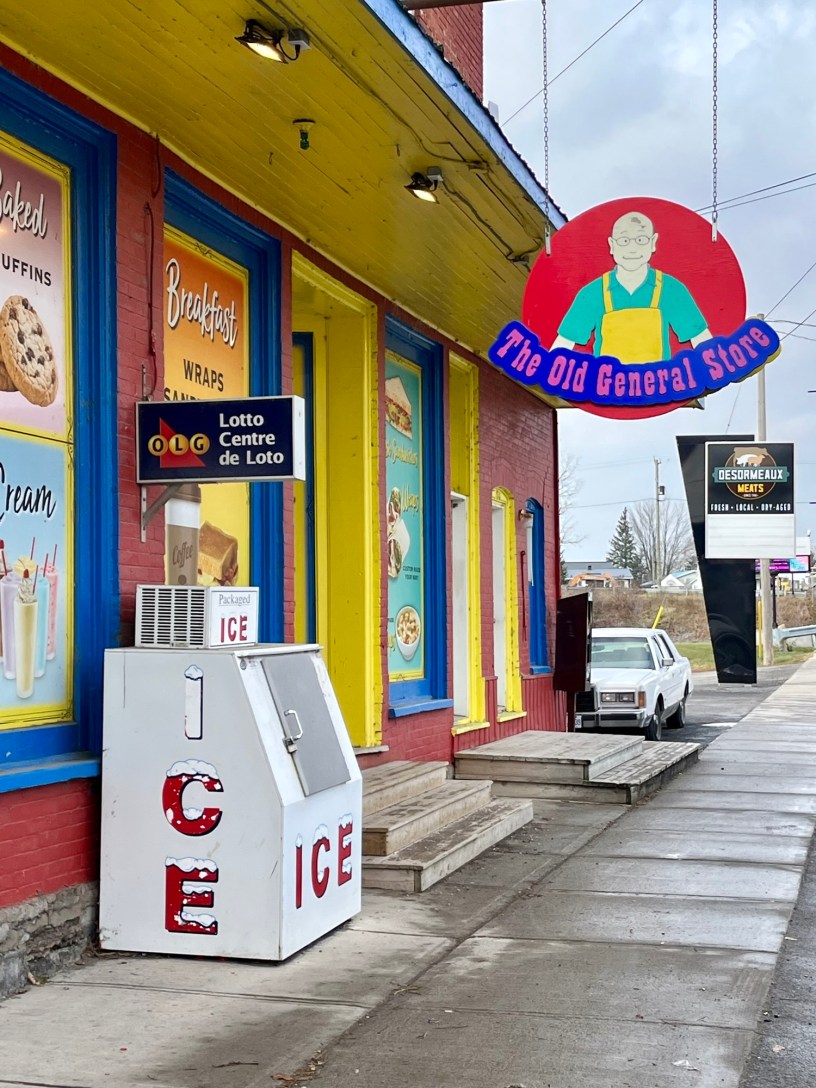
Except for its age, my aunt’s store was a lot like the one in my own community today, the Crysler Old General Store.
My aunt opened her store at 5:30 every morning except Sunday, when it was apparently safe to wait until 8:00. Why so early? Because the construction workers building the nearby subdivision, along with contractors who lived in the area, came there for breakfast. They arrived from miles around. The front and side parking lots would fill with pickup trucks, dump trucks, cement mixers and the occasional car.
When I visited, I stayed upstairs, where my aunt and uncle lived. Every morning the rich aroma of bacon and eggs permeated the entire building. That was usually my signal to venture downstairs.
I loved eating breakfast “with the guys.” The place would be packed with workers waiting for their eggs or socializing over coffee.
Half of my aunt’s store was restaurant. The rest was the most incredible collection of food, snacks, cigarettes, toys and the latest electronics imaginable.
“No room for TV consoles,” my aunt said. “They take up too much room.” This despite the fact that they were all the rage at the time.
The coolers held soft drinks and milk in recyclable three-quart plastic jugs, along with quarts of chocolate milk and bottles of homo milk with cream on top. My aunt told me she was the first store in London to sell the three-quart jugs and that she sold more milk for Silverwood’s Dairy than any other store in the city, grocery stores included.
There were freezers filled with ice cream, Freezies and Popsicles, along with frozen TV dinners and french fries. She sold meat obtained from a local butcher. Elsewhere were rows of groceries: canned vegetables, ketchup and mustard, cereals, hot dog buns and bread. Lots of bread. And chips, including barbecue, my favourite.
She even stocked towels, facecloths and blankets, including the “newfangled” electric ones. She bought them on sale at Kmart, her favourite place for bargains.
And then there was the candy.
Behind glass was a treasure trove of black balls, Swedish Berries, Twizzlers, sour cherries, wax lips and a seemingly endless assortment of other treats, carefully dropped into paper bags when purchased so the pleasure could be savoured one piece at a time.
And then there were the toys!
My aunt tried selling toys one year as an experiment. They were so popular she soon found herself making several trips a month to the distributor in Port Burwell for more. She carried dolls and buggies, Monopoly, Sorry! and other popular games, electric trains, Dinky cars, roller skates, hockey equipment, guitars, record players and, of course, transistor radios.
When they arrived a little later, she sold cassette recorders and 33⅓-rpm albums. My aunt was an early adopter of small, inexpensive electronics.
I also loved going through the old 45s she sold after they had spent their useful lives in the restaurant jukebox. Teenagers, she discovered, were quite happy to buy the old records at bargain prices.
At Christmas, people came to the store to buy toys because, they told her, she was cheaper than Simpson’s and always seemed to have whatever was popular.
My aunt did most of the cooking. Not just breakfast, either. Lunch and dinner, too. Families came for fish and chips, steak dinners or sometimes just dessert with ice cream. She made fantastic strudel, and her apple pie with cheddar cheese on top was famous.
When she wasn’t cooking or serving customers, she was washing and drying dishes, all by hand.
She never stopped working.
My uncle tended the front of the store, serving up “smokes” to the workers or making milkshakes with real ice cream and milk. He would also scoop ice cream for the nearby high school students who descended on the store at lunchtime.
Ice cream cones were a specialty. Nothing less than two scoops at this store!
I helped with the cones when I visited during the summer. By the time I finished scooping, I’d have ice cream from my wrist to my elbow. But the best part was when my aunt told me I could have as many scoops on my own cone as I liked.
At 10:30 at night, my uncle would finally go to the front door and turn the “OPEN” sign to “CLOSED.” Then he and my aunt would go upstairs and begin counting the money.
There were no credit or debit cards in those days, although my aunt selectively allowed trusted customers to run an account and pay monthly.
And, of course, someone would inevitably knock on the locked store door. They needed aspirin. Or Tums. Or milk. Or something else they had suddenly decided constituted an emergency.
The store seemed never to close.
I don’t know when my aunt and uncle went to bed. There was change to count and roll, cash-register receipts to balance and bills to pay. My aunt wrote cheques, although some people had to be paid in cash, their names prominently written on envelopes.
She did the finances while consuming an enormous quantity of Coca-Cola in those little glass bottles. No Diet Coke in those days and definitely no Pepsi for her.
My uncle would cook up his customary macaroni and cheese, which he ate in huge quantities as he worked on the books. When he finished, he would head downstairs again to clean the floors and haul the empty pop bottles to the basement. Those bottles were almost as good as cash to some customers in those days, but they were heavy and dirty for my uncle to lug around.
Seven days a week, 364 days a year. They worked every day except Christmas.
Looking back, I have no idea how they did it.
They were always polite to their customers, although my aunt tolerated no one bothering anyone else. Offenders would be sternly told to leave. She ran a tight ship.
I remember her telling me about the day a local high school teacher had to escort several students back to the store to clean ketchup from the ceiling after they had apparently thought it would be fun to write their names up there.
My aunt wasn’t amused.
Many years later, the first time I walked into the Crysler Old General Store, all those memories came flooding back.
The resemblance was uncanny. The Crysler store also opens early, serving local contractors and early risers. There is a food counter and coolers filled with sandwiches and other ready-to-eat food. There are cookies, coffee and rows of candy and chips in more flavours than my aunt could ever have imagined. And, of course, there is an ice cream counter.
Wandering through the store, I see many of the same groceries. There is still milk, although the three-quart jug has given way to four-litre bags. A few toys sit on upper shelves, more as background now than the bounty my aunt once displayed. There is even a church pew by the window where people can eat lunch or linger over coffee and a cookie.
The Crysler Old General Store has been part of the community for generations. Its wooden floors are well trodden, and its exterior could use a facelift. It isn’t particularly elegant.
But somehow that makes it all the more endearing.
There are regulars who stop for lottery tickets, milk, chips, soft drinks and special candies. In warmer weather, they come for ice cream. The store collects donations for the food bank and holds raffles for worthwhile local causes.
More importantly, it remains a gathering place.
Whenever I go in, I’m reminded that stores like this have never really been just stores. They survive because of people willing to open the doors early in the morning, greet the regulars, serve the coffee, stock the shelves and come back the next day to do it all again.
That is what I now understand about my aunt and uncle.
As a boy, I thought their store was magical because it had everything: candy and milkshakes, toys and electric trains, records and transistor radios. I didn’t notice the alarm clock going off before dawn, the dishes washed by hand, the endless bookkeeping or my uncle hauling empty pop bottles to the basement long after the customers had gone home.
I notice those things now.
Eventually, when their health began to fail, my aunt and uncle sold the store to Silverwood’s Dairies. It became part of the Mac’s Milk chain, and the business changed hands again in the years that followed.
I don’t know whether my aunt’s old store is still there.
But a trip back to London to look for it is on my bucket list.
I doubt I’ll find the aqua-blue transistor radio.
I’m not entirely sure that’s what I’d be looking for anyway.

