As Remembrance Day approaches, poppies appear on lapels, flags are lowered, and familiar words return: “We will remember them.”
Recently, while walking through my neighbourhood, I noticed one such sign. It simply read:
“We Will Remember Them.”
Immediately, I thought of a story my father once told me.
My father served for four years in Europe during the Second World War. Like many veterans, he rarely spoke about his experiences. One story, however, stayed with him all his life.
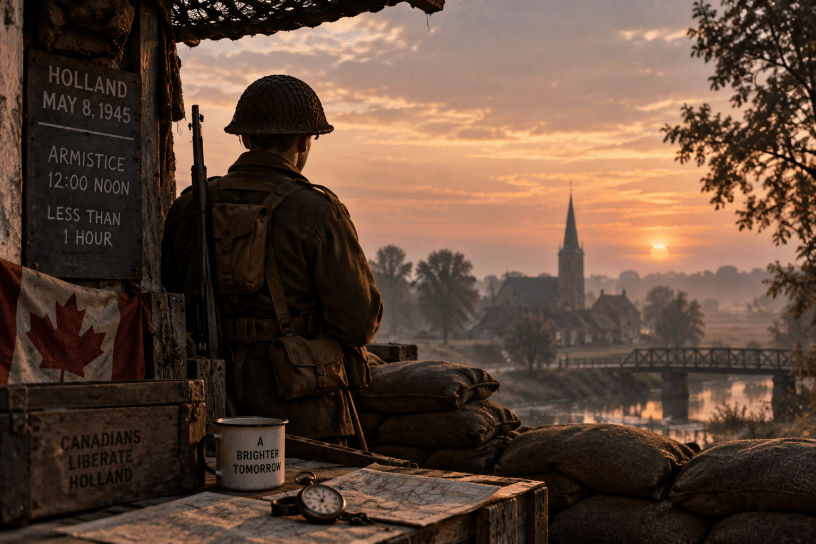
He was in Holland on VE Day in May 1945. A close friend of his was standing guard that morning. The German surrender was scheduled to take effect at noon. There was less than an hour remaining before the war would officially end.
A sniper’s bullet killed his friend before the armistice took effect. Imagine surviving years of combat only to lose your life in the final hour of the war!
The sign said, “We Will Remember Them.”
But as I reflected on that message, I found myself thinking not only of the soldiers who died, but also of the people who survived, the memories they carried, and the way those memories were passed on to people like me.
I never fought in a war. I never served in the armed forces. Yet warfare has affected me through the people I knew and the stories they entrusted to me.
Growing up, I occasionally met some of my father’s wartime friends. One was Jimmy Jacobs. As far as I knew, Jimmy never worked after returning from the war. At the time nobody spoke of PTSD. In those days men simply carried their burdens silently. Looking back now, I wonder how much Jimmy suffered from memories he could never escape.
Another of my father’s friends was Roy Muir.
Roy had lost an arm at Dieppe.
As a young boy in the 1950s, I remember visiting Roy and Betty’s home. My attention was captured by a lamp shaped like a bomber aircraft that lit up at night. To a young boy, that seemed fascinating.
As the years passed, however, I became much more impressed by Roy himself.
I watched what he could accomplish with one arm. The determination required simply to live an ordinary life left an impression on me that lasted long after childhood. My father told me once how Roy lost his arm during the Dieppe raid. It was not a pleasant story, and it was one I never forgot.
Decades later, that memory returned unexpectedly.
When I was fifty years old, I enrolled in an Executive MBA program. Part of the program included a two-week trip to Europe. One of our professors happened to be a military historian, and alongside the business curriculum we visited several important Canadian military sites from both World Wars.
Our first major stop was Dieppe.
The evening we arrived, we walked through the town. What I remember most were the scars. Some buildings still bore marks left by bullets. Small memorial plaques marked locations where soldiers had died. Even sixty years after the war, reminders remained embedded in the landscape.
And the French, I discovered, had not forgotten the Canadian soldiers who died there.
The next morning we walked to the beach.
Whether it was the tide or simply the geography, the shoreline seemed impossibly steep. We learned how Canadian soldiers landed under fire while German defenders were already prepared for their arrival. As we climbed from the water’s edge toward the town, the futility of the assault became painfully obvious.
Church steeples had been turned into observation posts. Guns overlooked the beaches. Higher ground surrounded the landing area.
Standing there, I found myself thinking about Roy Muir. For the first time, I could visualize what he had experienced.
Later that day, we visited a German gun position overlooking the beach. Several visitors were present, including Canadians and Germans.
An elderly German man approached one of the gun emplacements and suddenly he began to sob.
His wife, speaking in English, explained that he had served there during the battle. He remembered his commanding officer ordering him to continuously fire on the Canadian soldiers struggling up from the beach.
The grief from that experience had remained locked inside him for more than half a century.
Even now, the memory of that moment affects me. It was a reminder that war leaves wounds on all sides.
Not long afterward, we visited the Canadian military cemetery. Row upon row of identical white headstones stretched before us. As I walked among them, reading names and ages, I found myself crying. Most of the soldiers were teenagers or barely into their twenties.
At the time my own son was twenty-one years old. Looking at those markers, I could not stop comparing those young men to him. Their lives had barely begun. Their futures had disappeared before they had a chance to live them.
Dieppe was an emotional experience. I thought nothing could affect me more. I was wrong.
The following day we visited Vimy Ridge.
As our bus entered the area, the driver pointed out the uneven terrain. The landscape itself still reflected the violence of the First World War. Shell craters and scars remained visible nearly ninety years later.
The Vimy Memorial rises majestically above the ridge. Its beauty is undeniable.
Yet what struck me most were the names engraved on that monument. Thousands upon thousands of names. Every one represented a son, a brother, a husband, a friend. The sheer scale of loss was overwhelming.
The day was damp and foggy. Our guide remarked that Vimy often seemed wrapped in mist. Somehow, it felt appropriate.
We toured the underground tunnels where Canadian soldiers waited before battle. Cape Breton miners had been recruited because of their expertise in digging. In some places, German tunnels lay only a short distance away.
It all seemed so absurd. Young men from different countries, living underground, waiting to kill one another because governments had ordered it.
One room particularly stayed with me. It contained beds with actual mattresses. Soldiers selected to participate in an upcoming assault were sometimes allowed the privilege of sleeping there before going over the top. It was described almost as a final kindness, a last rite.
Our guide then showed us a collection of items recovered from the surrounding ground over the years. Fragments of bones. Pieces of rifles. Grenades. Personal belongings.
The guide himself, a retired Canadian soldier, became emotional while speaking. None of us failed to notice the tears in his eyes.
Neither did we miss the message. War may end. Its consequences do not.
The next day we travelled onward to Frankfurt and there our professor delivered shocking news. The guide who had shown us Vimy Ridge had been killed. While collecting artifacts, he had picked up an unexploded grenade which detonated.
Eighty years after, the war still claimed another victim.
I have often reflected on all these memories. My father’s friend killed an hour before peace. Jimmy Jacobs carrying invisible wounds. Roy Muir losing an arm at Dieppe. The German soldier crying at the gun position overlooking the beach. The rows of young Canadians buried far from home. The retired guide killed decades after the fighting ended.
When I think of Remembrance Day now, I no longer think only of those who died. I think of those who came home carrying burdens the rest of us could barely imagine. I think of the families who inherited those stories. I think of how memories are passed from one generation to another.
The sign on my neighbour’s lawn was right.
We will remember them.
But remembrance is more than a ceremony or a moment of silence. It is the need to hold onto the stories, those memories, and to continue to understand the personal cost of wars.
Lest we forget.

