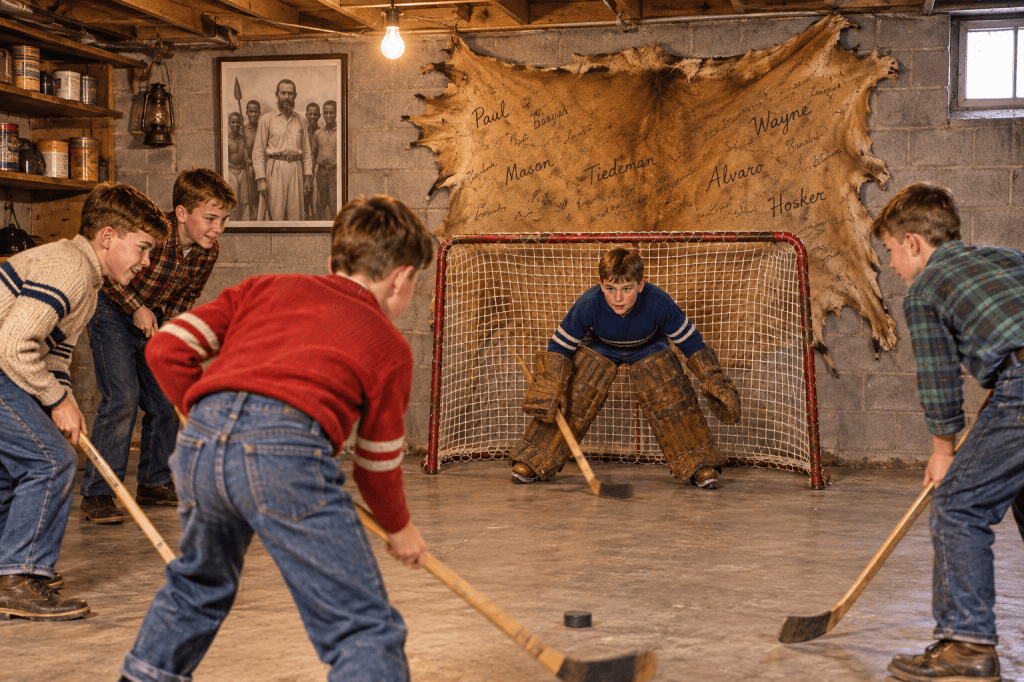
It’s hard for those who aren’t Canadian to understand the importance of hockey in a young Canadian’s life. And true to form, this is a hockey story, with a little twist.
In my day, kids made their own hockey rinks in neighbourhood backyards. Our neighbourhood was full of hockey nuts, and every winter we built our rink at the Northeys.
The Northeys were special people who obviously loved kids. Their home was the original farmhouse for our subdivision, sitting on a large lot perfect for hockey rinks. Winter meant hockey, spring brought endless hours in the multi-roomed tree fort, summer meant baseball pitching and run sheep run and fall often ended with tomato fights behind the Northey’s garage.
When the first snowfall arrived, everyone knew what to do.
“Get to Northey’s!”
No phone calls were needed. Kids appeared from every direction pulling wagons (the preferred collector) and toboggans, carrying aluminum snow scoops (the best) and shovels. The goal was simple: gather enough snow from neighbourhood lawns to build the rink.
Paul Northey, the oldest and most experienced, quickly organized us.
“Mason, Tiedeman and Alvaro, take Spencer Street, then Stevenson Ave. Hosker, McCready and Wayne (middle Northey brother), head down Hale Street. But stay away from Mrs. Bruntman’s place or she’ll call the cops again. McGuffin and O’Neil, you take Glass Ave and Cornish Crescent.”
Then we were off.
For hours we hauled wagonloads of snow from lawns throughout the neighbourhood. When they saw us, neighbours knew what was happening and said nothing. Some houses where the grouchy neighbours lived were avoided entirely. And nobody touched the McCloskey lawn because Sparky the dog left surprises everywhere. We wanted only pure snow for our rink.
Load after load was dumped onto the growing pile at Northey’s. When enough had accumulated, we trampled it down, rolled it flat, positioned the heavy steel nets that Mr. Tiedeman had made special for us, and flooded everything with hot water from a hose connected through the basement window. Hot water was the best for making rinks.
The rink took shape slowly, and we nurtured it for days as temperatures allowed. Every evening kids gathered to check the ice, repair rough spots and test the lights that hung from the clothesline, garage and apple tree.
Between work shifts, we practised hockey in the Northey basement, shooting pucks at a spare net set up against the room dividing wall.
Then one year, something changed.
We all knew about Uncle Charlie Northey, a missionary somewhere in Africa. Letters from him described life in remote villages where water was scarce and lions roamed nearby. We loved to hear about his strange surroundings and lifestyle.
His photograph hung on the basement wall (Strange because all of the other Northey family pictures were upstairs, prominently displayed). In the picture, Charlie stood with villagers holding spears. He had a long beard covering his face and deep-set eyes. He looked as though he belonged there more than in Canada.
One afternoon Paul came downstairs carrying a package.
“It’s from Uncle Charlie,” he announced.
Inside was the skin of a lion.
According to Paul, the lion had become a man-eater and had killed several villagers. The entire village joined a hunt and eventually killed it. Uncle Charlie decided his Canadian relatives should have a genuine lion skin since lions weren’t exactly common in Ontario.
Mrs. Northey was not enthusiastic about the gift.
She instructed Paul to staple it to the basement wall where we played hockey.
And we all helped Paul do it. How many Canadian kids can say they helped staple a real lion skin to a basement wall?
When we finished, the tan-coloured, headless hide stretched across the wall behind the hockey net. Mrs. Northey said we could continue playing hockey as usual and we could even write our names on the lion skin if we wanted.
Everybody signed.
The poor lion hide spent the entire winter absorbing slapshots, wrist shots and countless missed shots on goal. It became just another piece of our hockey world.
But nothing generated more interest at school than the story of Uncle Charlie’s lion. And the other stories we made up about his life.
Years later, after I was married and had moved away, I occasionally visited Wayne Northey, and sometimes we stopped in to see his parents.
One time we wandered downstairs to the old basement.
Funny how emotional it seemed for me. Very little had changed. Uncle Charlie’s picture still hung on the wall.
And beside it was the lion skin, worn, tattered and scarred from years of hockey practice. Those signatures were still visible on its hide.
I haven’t been to Northey’s for many years now. Sometimes I wonder what happened to that lion skin.
But mostly I wonder what happened to all the kids whose names were written on it.