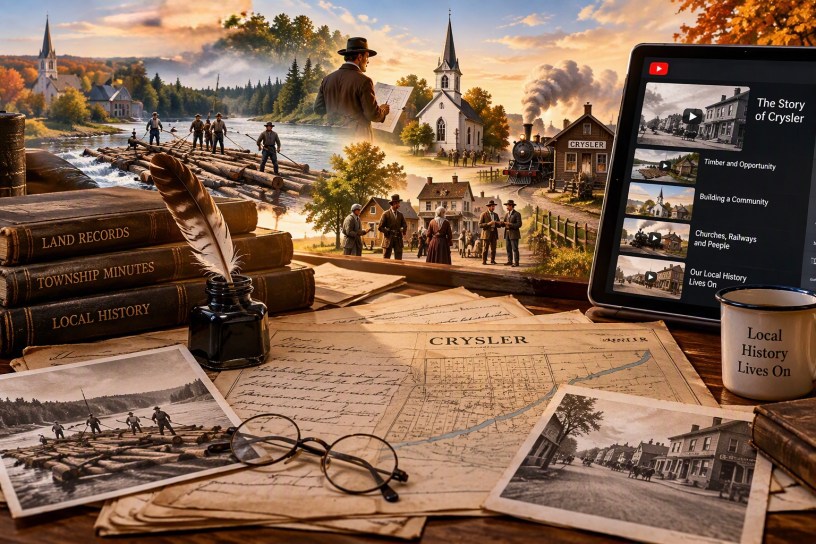
“A little learning is a dangerous thing.”
Alexander Pope’s famous observation has been quoted for more than 300 years. Historians often use it as a warning against drawing conclusions from incomplete evidence.
As I have become increasingly involved in researching the history of Crysler and other villages of Eastern Ontario, I have begun to wonder if there is a different danger lurking in local history today.
What if in trying to avoid every possible error in historical research, we forget how to make history interesting to the current public?
I am not chastising research. On the contrary, sound research should be the foundation of everything we do. But if local history is to survive in a world increasingly dominated by screens, social media, videos, and short attention spans, we need to think differently about how we recount our history.
The evidence of that shift is hard to ignore. A major U.S. study in 2025 found that daily reading had declined by about 40% over the two decades ending in 2023[1]. Americans over fifteen reported spending only about seventeen minutes a day reading, compared with more than two hours watching television. In Canada, 90% of a study’s respondents said they watched video, television, or movies weekly; 86% browsed social media; and only half said they read or listened to books weekly[2].
For educators and historians, the challenge is not simply to lament that change. It is to ask how people might still find enjoyment, meaning, and curiosity in historical knowledge when the medium through which they receive it has changed.
That question became concrete for me after moving to the village of Crysler five years ago.
Like many newcomers, I was curious about the community in which we lived. I quickly discovered that Crysler possessed a rich history. I also discovered that conventional historical reporting didn’t seem to be reaching modern audiences.
As I began researching more, and later producing YouTube videos about local history, I noticed a revealing pattern. Some viewers wanted dates, buildings, and events. Many others were drawn first to personalities and to dramatic moments: floods, tornadoes, battles, fires, and the decisions people made when ordinary life was disrupted.
In short, they wanted stories more than facts.
That realization became especially clear as I studied the Crysler family itself. Their story shows both the value of solid research and the need to give historical facts a human shape.
Like many people, I originally assumed there was one John Crysler. He of course was the founder, the one whose name the village inherited and the one whose farm was the staging area for the decisive engagement between the British (Canadian) and American forces in the war of 1812-14.
The more I researched, however, the more complicated the Crysler story became. There was not one Crysler. There were several. And each helped shape local history in a different way. Each had a unique personality that was hardly mentioned in historical accounts.
The first and best known was John Crysler, the son of a Loyalist family with German Palatine roots that had lived in northern New York before settling in Upper Canada after the American Revolution. As a twelve-year-old boy, John and his fourteen-year-old brother Geronimus joined Butler’s Rangers as drummers. That early experience seems to have helped shape a lifelong allegiance to the Crown, a respect for discipline, and a familiarity with the frontier landscape where he was raised.
When the family later settled near Morrisburg, John became far more than the farmer his father had been. He was a landowner, mill operator, tavern owner, politician, militia officer, and timber entrepreneur. His mills served settlers who walked miles to have their grain ground; his stores supplied scarce goods such as salt and liquor; and his Montreal connections helped him obtain goods and profit from trade.
From 1803 to 1815 – the Napoleonic wars era, Britain’s demand for timber increased dramatically, and John Crysler recognized the opportunity. He acquired thousands of acres in virtually uninhabited Mountain and Finch Townships, much of it near the Nation River that could move white pine toward Montreal and British markets. In time, he became one of Eastern Ontario’s most successful businessmen, some might even call him a “timber baron”.
From a traditional historical perspective, most of that description is a collection of facts.
The history about the life of John Crysler can suggest something more for modern audiences. Crysler appears to have been energetic, ambitious, competitive, and quick to seize opportunity. He stood firmly for the Crown, opposed rebellion, entertained lavishly, cultivated powerful connections, and remained attached to military service even in old age. Such details do not allow us to invent a personality, but they do let us ask more interesting questions about the kind of man behind the offices and land records.
History will never call him a swashbuckler even though his life had many bold, brave, flamboyant, and exciting experiences. It has more safely described him as a member of the Upper Canada establishment: a Member of the Legislative Assembly for Dundas, a militia officer, a justice of the peace, and a man deeply tied to Loyalist values and British authority.
That is the factual legacy. But if we stop there, we miss the human force that made those facts possible.
That tension between historical record and personality becomes even more interesting when we move to the next Crysler generation.
The individual who arguably did the most to create the village of Crysler as we know it was not the early, famous John Crysler, but his son, John Pliny Crysler.
John Pliny understood economic change, but in a different way. Where his father had prospered through timber and frontier enterprise, John Pliny recognized the growing importance of settlement, transportation, land ownership, churches, schools, post offices, and railways. He acquired and managed property around emerging communities, encouraged commercial growth, and donated land for churches and other institutions.
In many respects he functioned as a shrewd community developer before that term even existed.
Yet today, few people even know his name. They regularly confuse it with his father.
Visitors to Upper Canada Village may admire the home associated with John Pliny Crysler – Crysler Hall. They may learn about its architecture, furnishings, and rural life. But are we paying more attention to the house than the person who built it?
The historical records provide facts.
But the storyteller sees a man trying to anticipate where development will occur and shaping that development before it takes place. John Pliny was like an early real-estate developer (a mogul?). He was a risk taker and a planner who understood that churches, schools, businesses, transportation, and land ownership all mattered if a settlement hoped to survive.
Even Crysler Hall, now preserved at Upper Canada Village, invites that kind of interpretation. Its brick construction, scale, Greek classical architecture, and careful design suggest confidence, ambition, showmanship, and a desire for permanence. The historical records may tell us that John Pliny was a businessman, politician, and churchman; the house hints at how he wished to be seen.
Then came another Crysler generation.
John Wesley Ralph Crysler, John Pliny’s son, known simply as Ralph Crysler in historical records, carried the family’s local influence into a later period. He supported religious institutions, served as postmaster for twenty-seven years, maintained family connections in Morrisburg. He became one of the last prominent members of the Crysler family that had shaped Eastern Ontario for decades.
Here again, though, the questions can quickly move beyond bare facts.
Why did Ralph sell the family estate in Morrisburg? Why did he choose to live in Crysler? Could it have been the tragic death of his only son in a railway accident near Crysler in 1898? What does his long service as postmaster suggest about his relationship to the community? Why did he build a brick home there, but one far less ornate than his father’s?
Taken together, these three men reveal why local history benefits from both evidence and interpretation.
What many people think of as “the Crysler story” is several stories.
A Loyalist entrepreneur.
A settlement builder.
A community supporter.
Three generations adapting to changing circumstances over more than a century.
Their story also points to the larger challenge facing local historians.
Most surviving records were never created to satisfy our curiosity about personality. They record transactions, appointments, land sales, tax assessments, legal disputes, and government decisions. Such sources are invaluable. Without them, we would know very little.
But they rarely tell us how people entertained themselves, what they worried about, argued over, or dreamed of accomplishing.
As a result, historians often face a difficult question.
How can they bring people to life without going beyond what the evidence supports?
For many academic historians, the answer leans heavily toward caution. There are good reasons for this. Speculation can become distortion. Assumptions can become myths. Errors can spread rapidly once repeated often enough.
As my former history professor once said: “History is never made up of things that might have been”.
Yet there is another modern reality we must acknowledge.
Most people do not encounter history through academic journals. Today, they investigate it through podcasts, YouTube videos, social media posts, historical novels, television programs, and increasingly through short-form digital content. Even museums and heritage sites are being asked to provide more direct, visual, and participatory experiences, especially for younger audiences.
Audiences today are not seeking complete mastery of the subject. Instead, most are seeking an entry point, a short take away.
When I prepare a video about a nineteenth-century village, I quickly discover that viewers are not captivated by assessment rolls. They are captivated by the general store owner who handed out hip waders to local residents in times of horrific floods. They are interested in the railway worker who fell off the railway bridge and was heroically saved by quick thinking nearby workers. They want to know why one village flourished while another declined, the people that made that happen and how they did it.
In other words, they want to hear entertaining stories that make them understand the past.
Without the human story, we are often left with little more than a catalogue.
The goal should not be choosing between accuracy and engagement; it should be about how to combine them.
The history of the three John Cryslers demonstrates the possibilities. The historical record allows us to see entrepreneurs, politicians, developers, church supporters, landowners, and community builders. It also gives us a glimpse at ambition, foresight, loyalty, success, and occasional controversy.
While we should never invent what we cannot support, neither should we be afraid to explore what that evidence offers. Doing so may inspire a new digital generation to become curious about the past.
And curiosity is where all historical learning begins.
[1] See UCL News, “Proportion of Americans reading for pleasure fell by 40% over 20 years”, https://www.ucl.ac.uk/news/2025/aug/proportion-americans-reading-pleasure-fell-40-over-20-years
[2] See BookNet Canada Study: https://booknetcanada.ca/blog/2026/05/05/canadians-and-their-leisure-time-in-2025-leisure-reading-study/

