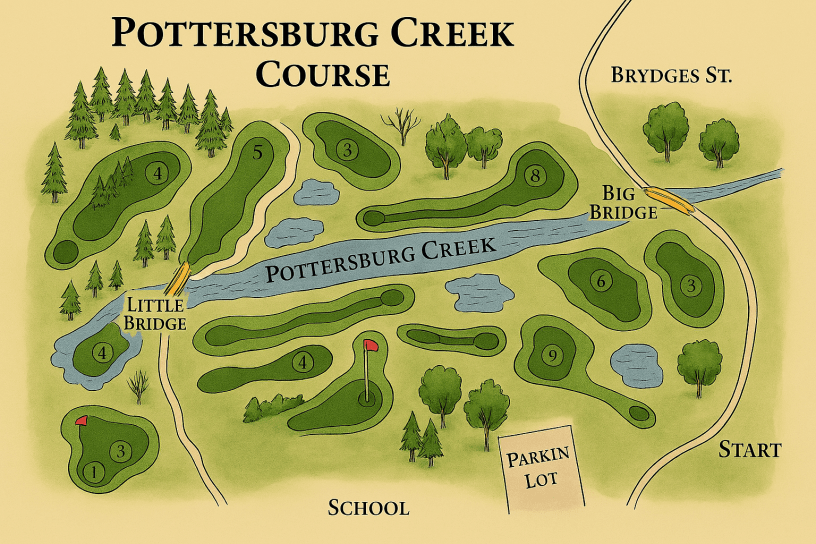
The calendar just flipped over to March. And while the temperature here today is a frigid -18 degrees (Celsius), I was reminded of my younger days as a kid when I couldn’t wait to play golf when March came round. Near our house was Kiwanis Park, a huge long green area that spanned the length of Pottersburg Creek. In early spring, the Creek swelled with snow melt run-off as the temperatures rose and the spring rains began to replace the blizzards that had characterized our Februaries. Because winter had frozen the ground several feet down, the lands adjoining the Creek were characterized by mini-lakes of interim standing water. The entire area was more water than land. But it was a great location for a golf course!
By mid-March I could last no longer. I put on my rubber boots (the Brits might call them Wellingtons) that came up to my knees. I donned my spring coat and golf hat, and over my shoulder I draped my golf bag, filled with golf clubs that had been cleaned for the impending golf season. I put on a right and left handed golf glove since invariably my hands would get wet (and cold) at that time of year. With excitement in my step, I left the house prepared to begin my Spring golf ritual.
Spring golf at Kiwanis Park was not like playing on a regular golf course. The first thing I needed to do on arriving was to lay out the course design, since every year water sat in different locations and it was necessary to have relatively dry “fairways” to play on. The water hazards were fun to design around and of course the golf holes had to be on the top of hills, visible from low spots, but also in locations where the ball would not be lost in muddy patches. Instead of putting, I chipped into holes which were purposely larger to accommodate chip-ins. And even though the deciduous trees had no leaves, it was fun to incorporate their locations into doglegs.
I must have been a nerdy kid for I also carried a writing pad and several golf pencils in my bag which I pulled out upon my arrival at the Brydges Street bridge-“big bridge”, the natural starting point for any course design. Busily I would draft my course and later at home I shaded and coloured it and made it look more like the designs which characterized golf course score cards.
“Big bridge” provided an excellent view of the Creek and parkland on either side. I would sketch the “hole locations” and “teeing grounds”, ensuring an equal collection of par 5’s, par 4’s and par 3’s. Fairways were not as easy to delimit graphically, since there was always an abundance of standing water which in my designs served either as hazards or when playing, as points of relief. To be fair the holes would be shorter in overall length than regular courses as there was no roll to speak of when hitting the ball. In fact, I carried a number of extra balls in my bag in case the balls disappeared into mud in the “fairways”, or I mistakenly hit a ball into the many water hazards that were part of my course design.
I would try to design nine holes, but sometimes there would be fewer if access over the “little bridge” had to been limited. The “little bridge” had been put in place for school kids to get home via a shorter route when the weather was drier. And despite teacher warnings in the spring, many attempted the crossing. Saying you came home via “little bridge”in March or April was a status thing for adventurous kids. Many crossed it with minimal soakers and it gave them bragging rights for a few days. One time, though, I recall the fire department had to rescue a child who started across “little bridge” and found himself grasping the handrails while the swift current went over his boots.
Regardless of the status opportunities, practically speaking as a spring golf course designer, “little bridge’s” often-flooded deck and associated pathway made it undesirable for ball landing or placement, so the design often had to avoid crossing the Creek via “little bridge”.
In my bag I brought along some bamboo poles, the ends covered with little flags that I had taken from my mom’s rag bag. I had carefully stapled the rags onto the bamboo pole ends. After completing the design, I had to walk the course before finalizing it. Often it was necessary to reinstall “Pins” onto higher ground. I’d push them as far down into the ground as spring thaw would allow. Carefully then, I would inscribe a three foot diameter circle around each “Pin” with white spray paint left over from the previous summer’s baseball field layouts. (During the summer we used the paint to identify baselines for our baseball diamond which we built at the far end of Kiwanis Park near the cemetery. We used the cemetery chain link fence there to delimit the home run area, but that is another story).
I did not use tee markers for the Pottersburg course, as tee-off locations had to be shifted, depending upon the day, onto drier areas to ensure that the balls were struck without the intrusion of water or high grass. Getting a good first shot was a critical part of playing the course, as second and subsequent shots were often played from difficult “lies”.
I don’t mean to brag, but I had my first hole-in-one on the Pottersburg Golf Course at the age of thirteen. How many people have had a hole-in-one at the age of thirteen? For the record, I hit a perfect five iron (probably about 125 yards) from one side of the Creek near “big bridge” to the other side, landing just in front of the bamboo flag, hitting it and coming to rest within the three foot designated “hole” area. I didn’t see where it came to rest until I crossed “big bridge” and looked down to see my ball resting within the hole boundary. While I told several of my friends later about this amazing shot, sadly, they did not share my enthusiasm. But for me it was an incredible achievement! And it was truly remarkable for another reason: sixty-five years later, it was my first (and only) hole-in-one.
I loved playing spring golf. I’d play most of the day. I’d pack a peanut butter and jam sandwich and some Oreo cookies into my golf bag, along with my Davy Crockett canteen full of “Freshie”- strawberry was my favourite. When I completed a round for whatever number holes I had constructed, I would take some time out to wade out to the big concrete rocks conveniently left from some earlier mysterious construction project in the middle of Pottersburg Creek near “big bridge”. I’d lay on the rocks eating my sandwich and Oreo cookies. If the sun was warm I’d place my canteen strap around my waist and let the canteen cool in the fast flowing waters of Pottersburg Creek.
It was many years later that I read a newspaper article that said that the Ministry of the Environment had found excessive fecal matter in the Creek, presumably emanating from the slaughterhouse several miles upstream from my “course” grounds. “Never hurt me”, I asserted, “but the Creek sure kept my canteen contents cold”.
You gotta love spring golf!

