My sister lived in Williamsburg for several years, and when we visited her the village was exactly what you’d expect of a quiet Eastern Ontario community. There was a butcher with an impressive selection of meats — including thick‑cut bacon that could fill the entire house with delectable smells on a Sunday morning. A small general store, a tea-and-nick‑knack shop, a garage, a funeral parlour, and, somewhat surprisingly, a golf‑cart store rounded out the businesses dotting the local streets.
Some of those businesses have since disappeared. The butcher is gone, and the golf‑cart shop has vanished. But one of my favourite “comfort” spots in all of Eastern Ontario has taken root: Sherry’s General Store. It is a magnet for truckers and locals alike, offering some of the best baked goods in the region. The parking lot is often full of truck drivers eating lunch in their cabs, gazing across the parking lot toward the cemetery — unaware that they are looking at one of the earliest burial grounds in Eastern Ontario.
A Cemetery Steeped in Early History
Established in 1822, the Union Cemetery holds the names of some of the first families to shape early Upper Canada. Many were United Empire Loyalists of German heritage who settled here after serving with the British during the American Revolution (1776). Names like Casselman, Whitteker, and Marsalis appear here, and again and again across the region, reflecting the wide distribution of land grants awarded for their service.
In 1828, the cemetery was sold to Presbyterian and Lutheran families. Sadly, it has not been well maintained. Observers today will see leaning stones, broken markers, and the quiet erosion of a once‑significant historic site.
Williamsburg Township: Some Historically Notable Figures
Sleepy now, it was once part of a vibrant area. Williamsburg Township — which once included what is now Morrisburg, Ontario produced or attracted many prominent figures. Very early on the Gallinger family received extensive land grants after six members of that family served with the British in the American Revolutionary War.
John Crysler, of Crysler’s Farm fame, lived in nearby Morrisburg, as did later his son John Pliny Crysler, a landowner and politician whose home, Crysler Hall, is now preserved at Upper Canada Village. John Senior’s farm served as a strategy room and hospital for the British troops in a deciding battle that turned away the American insurgents in 1813.
Sir James Pliny Whitney, Ontario’s sixth premier, was born in Williamsburg (note his title). Sir James Morris, though not born locally, championed the construction of the Williamsburg Canals in 1838, shaping the region’s development.
Yet none of these figures drew the attention — or the crowds — that one rural doctor did.
Dr. Mahlon Locke: The Foot Doctor of Williamsburg
Perhaps the most remarkable, and today under‑recognized, resident of Williamsburg was Dr. Mahlon Locke, the so‑called “foot doctor.” During the Depression years, from 1930 until his death in 1942, his reputation spread across Canada, the United States, and even overseas. Thousands came seeking relief from arthritis and other ailments. Rich or poor, they all came with hope and determination to be cured.
Born in Dixon’s Corners, Ontario, Locke attended local schools before graduating in medicine from Queen’s University in Kingston, Ontario in 1905. After a brief stint with Algoma Steel in Sault Ste. Marie, Ontario, he travelled to Scotland to further his medical training. There he developed a reputation for helping Edinburgh policemen who were suffering from flat feet.
He returned to Winchester in 1908 and served as the village doctor for 34 years — delivering babies, attending weddings, acting as coroner, and tending to the everyday needs of rural families.
The Blacksmith Who Changed Everything
In 1925, a local blacksmith came to Dr. Locke unable to continue his work. Locke diagnosed him with fallen arches, manipulated the man’s foot using a technique rooted in his Scottish training, and fitted him with an easily form of what we would now call orthotics. The blacksmith returned to work shortly afterward — and word of his improved condition spread rapidly throughout nearby communities.
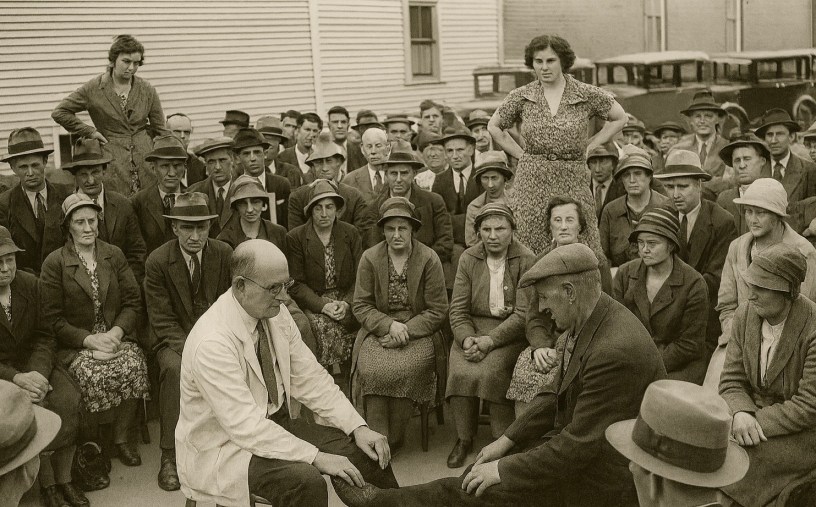
By 1930, Locke was treating up to 1,000 people a day under a simple awning roughly 30 feet square. He sat on a swivel chair, rolling from patient to patient arranged in a circle around him. Treatments lasted seconds. He charged one dollar, and often less (or even nothing) for those who couldn’t afford the fees.
Some people came for days on end to be treated, staying at local hotels and getting up early to stand in line to see the good Doctor. While quick and insightful in his diagnosis, he wanted to make sure anyone who needed his help could attend. And he worked long hours. Starting at six in the morning and often running until eleven at night.
He dictated to local hotels, anxious to charge high fees for visitors, that they must not charge more than one dollar a night. And they followed those instructions. Still, the hotel business boomed.
Aspiring patients came from all classes of life, some with chauffeur driven vehicles, others with home made mobility supports. Williamsburg was a perpetually crowded place.
Williamsburg Transformed
The impact on the village was extraordinary. Cars, wagons, and buses clogged the streets.
Hotels and restaurants sprang up. Medical‑supply shops opened.
Locals offered taxi service from and to the Morrisburg train station.
Wheelchairs and crutches filled the sidewalks.
And when Highway 31, that ran through the middle of town, was paved in the mid‑1930s, access improved even further.
Not everyone was thrilled, though. Residents found their quiet community overwhelmed, and some resented the constant influx of strangers. But during the Depression, the economic boost attributable to Dr. Locke’s fame was undeniable.
The End of an Era
Despite wartime pressures, crowds continued to come until 1942, when Locke died of pneumonia at age 62. No one could replicate his technique, and the phenomenon ended almost overnight. He was buried at Spruce Haven Cemetery near Brinston, only a few kilometres from where he was born.
With his passing — and with the war taking its toll— Williamsburg’s boom faded. Like many Eastern Ontario villages, it entered a long period of decline, though its families remain deeply rooted.
Was Dr. Locke a “Quack”?
In the era of travelling medicine shows and instant potions to treat every manner of affliction, you have to ask the question: “Was Dr. Locke a “Quack”?
Some in the medical establishment dismissed him. His method did not fit accepted theory. Treating a thousand patients a day looked like showmanship. And a rural doctor attracting international crowds? How possible was that? Skepticism was accepted, particularly among medical practitioners. Many said: “He must be a Charlatan”!
But the evidence complicates that conclusion. Many of his patients reported real relief. And some physicians quietly sent their hardest cases to him. His technique was grounded in anatomy, not mysticism. He charged very little and often treated the poor for free. He never claimed to cure arthritis — only to help.
Quacks deceive for profit. Locke did not. One dollar in 1932 was worth about $20 in today’s dollars. Compare that with the costs of chiropractic or osteopathic help today.
Dr. Locke was a rural doctor who discovered a technique that helped many people, and the medical establishment simply didn’t know how to categorize him at that time (and the sad thing is, they still do not recognize him).
An article in the Morrisburg Leader excerpted from a Globe report published in 1932 offered first hand observation of Dr. Locke’s work:
“Medical history is being made at Williamsburg. There can be no greater mistake than to dismiss the gatherings of sufferers at Williamsburg as mere evidence of mob psychology.”
Today, the modest government-provided plaque marks his former home — far too small a tribute for a man who once brought the world to Williamsburg.
 MainstreetRob
Morning Bob:
Another great write up. However there is enough of content regarding Dr.Locke to present as a separate article. In current presentation he dominates the content.
Regards
Hugh
Sent from my iPhone