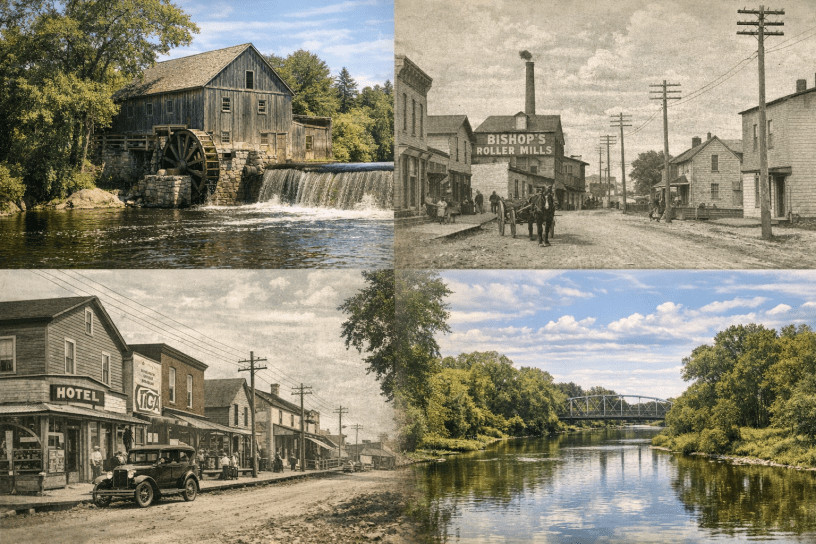
Unlike many villages in Eastern Ontario, Crysler has a uniquely layered growth story. Today it is becoming a modern commuter village. It began, though, as a mill hamlet and then a settlement created by a nineteenth century powerhouse family – the Cryslers. But its history is not a straight line from one to the other. It is a remarkable story focusing upon two main streets, two cultures, and two very different forms of community growth.
On the north side of the South Nation River in Crysler is Charles Street — an early pathway along the major transport vehicle of the time – the river. It initially became part of an engineered village, laid out by surveyors and shaped by the ambitions of the Crysler family.
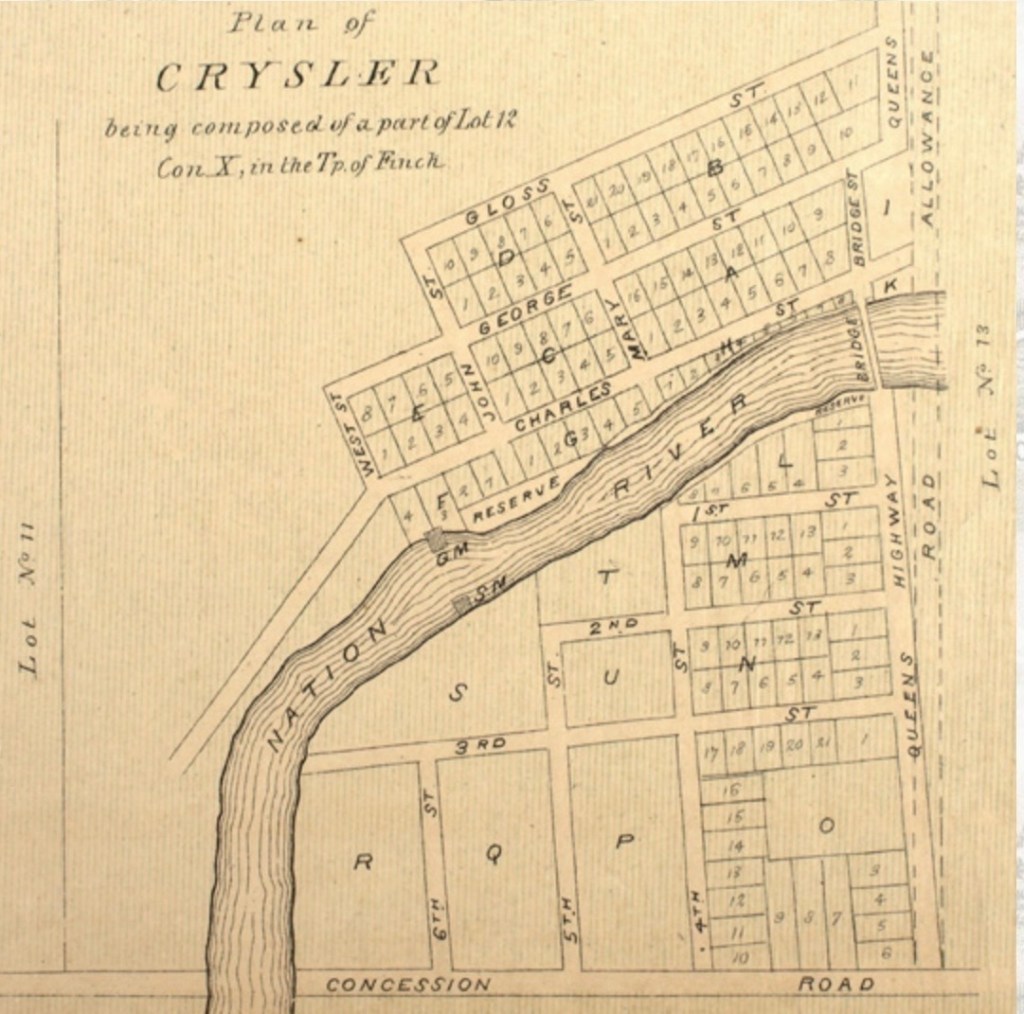
On the south side of the river is Queen Street. This is the organic village, built by francophone families who arrived later but stayed longer, enduring floods, fires, and economic shifts.
Together, they form the backbone of a village that has reinvented itself many times in its two centuries of existence.
A Mill Hamlet in the Wilderness (1806–1860)
Crysler began, like most Eastern Ontario villages, with a mill – two, actually. And the man who built the Crysler mills was like so many others who settled in Eastern Ontario at the time. He was of United Empire Loyalist stock, of German (Palatine)/American heritage. But unlike other early settlers, he had a strong penchant for business, and he became a well-connected politician, visionary, and opportunist.
Crysler’s founder was John Crysler, the man who gave the village its name – the same man whose name is synonymous with the decisive victory over the Americans in 1813 at his farm – “Crysler’s Farm” – near present day Morrisburg, Ontario. (Incidentally, the hero that day was not John Crysler who participated as a Captain in that battle, but rather Lt. Col. Joseph Morrison who masterminded a resounding victory over a much larger American force).
By the early 1800’s, John Crysler had amassed a considerable fortune by establishing taverns, stores, mills, and most of all, trade in timber prized by colonialist Britain. He cast his eyes toward the timber rich lands of Finch Township and began accumulating land and timber rights in that area.
In 1806, John Crysler built the first sawmill and gristmill in present day Crysler on the banks of the South Nation River. At the time, the lands nearby were not farmland, but rather virgin white pine forests with trees standing 100-150 feet tall.
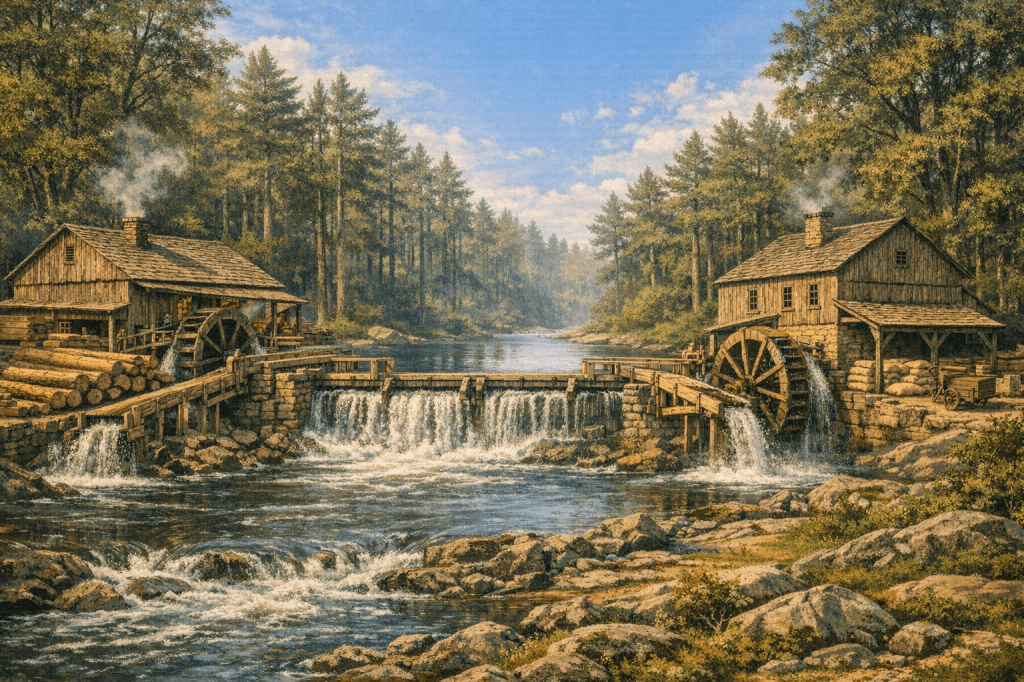
Men from neighbouring settlements helped to cut and dress the timber and float it down the river on rafts to waiting markets of the Royal Navy. John Crysler became a timber baron, and he owned more than 2300 acres of timber rich land within 10 miles of these mills.
For years, the sawmill functioned on the south side of the river, preparing the pine timber to be rafted along the river to Montreal to the waiting British, anxious to use those logs for their wartime sailing vessels.
On the north side was a grist mill to process the corn and grains from nearby agricultural land. Gristmills at that time were in short supply. Farmers and residents alike often trekked many miles just to bring their grains here to be milled.
Crysler built a dam to hold back the river waters to ensure a consistent flow for the waterwheels that powered the mills.
A nearby cluster of cabins housed workers who often lived there during the winter season when money was scarce and work was available there. By 1817 a cemetery had been established for those who died in those harsh times. Living in this area was very much a wilderness experience.
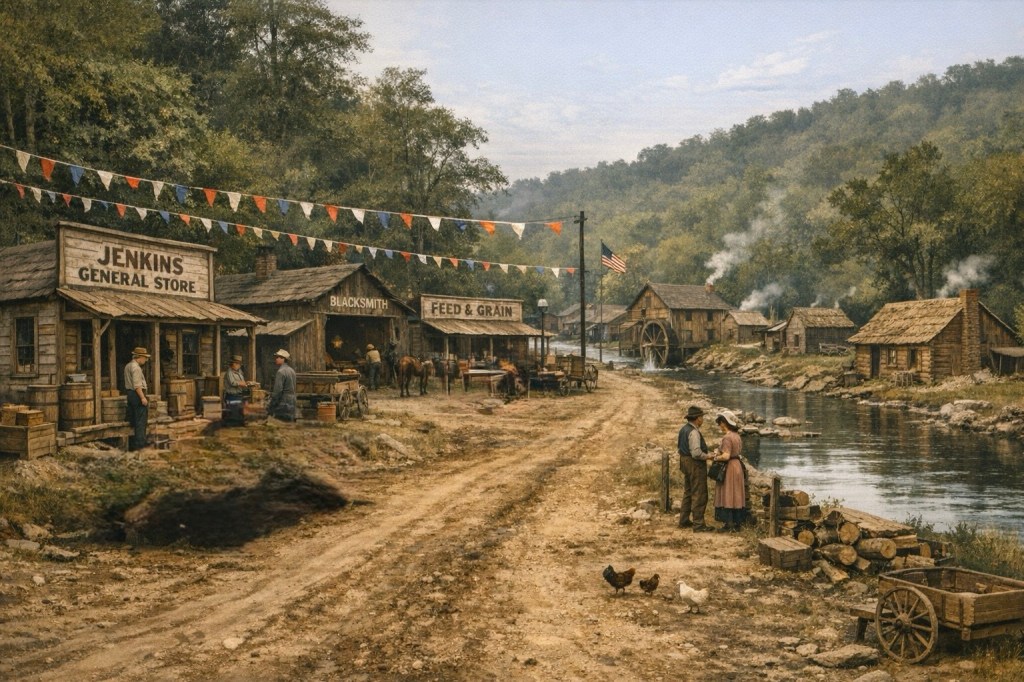
The early trail that paralleled the river eventually became Charles Street. Some of the early loyalist settlers erected homes there. Some served as general merchants to the mill workers, others as blacksmiths or even undertakers, but their homes were functional and not elaborate.
As for John Crysler, he spent most of his life in the Morrisburg area and throughout the more populated areas of Williamsburg Township south of this timber settlement. He often travelled to Niagara, Montreal or to Cornwall for political and business reasons.
Only occasionally did he venture north to see his vast timber-rich lands in Finch Township.
When he returned to the Crysler settlement to live his final years (1848–1852) in a small home near to the cemetery, he found a hamlet still defined by its mills and the South Nation River. There were very few residents.
John Crysler became the settlement founder, but not the settlement builder.
Crysler was not yet a village and when Crysler himself died, the settlement likely had no name.
John Pliny Crysler: The Settlement Builder
As John Crysler aged, his fortunes declined. His son, John Pliny Crysler, an astute businessman like his father had been, had a remarkable sense of the changing political and economic climate in Upper Canada. He too became wealthy and a prominent political figure, but in a different way.
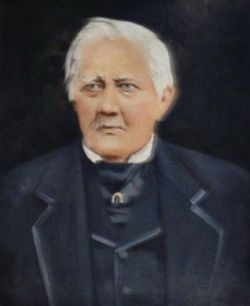
Through John Pliny, the Crysler family name continued as a powerful force in Eastern Ontario for over a century.
John Pliny Crysler had developed a different vision for wealth creation. The timber markets that had fuelled early riches for his father in Eastern Ontario had declined dramatically, although there was still a need for lumber. Agriculture – crop growing and livestock raising – was replacing timber harvesting as the population grew and farming became more established.
Creating settlements to serve those markets was the way to turn extensive land ownership and subdivided lots into a prosperous investment.
In 1867, John Pliny Crysler became the Registrar for the County of Dundas. In this role, he was responsible for maintaining all land titles, survey records, and property transfers for the entire County of Dundas. It was a position he held until his death in 1881, and it gave him a great knowledge of land availability and land values.
The Planned Village and the Railway Era (1860–1930)
With the help of this detailed knowledge of the County real estate, John Pliny reorganized the family holdings around his settlement vision. By 1879 he had divested much of the land his father had assembled south and west of the naisant village of Crysler in Finch Township. He then purchased additional land all around the community.
Crysler must have looked like an excellent candidate for long term growth.
He had a street grid survey made for the village and with a foresight that recognized the evolving importance of railways, he prepared the settlement for the arrival of the railway decades before it came. He sold or leased parcels along Charles Street to early settlers — Nash, Cumming, Johnstone, Cockburn — with a distinctly English institutional core.
He supported building the Anglican Church in 1864, and donated land for the creation of the Catholic Church in 1870. Churches were a fundamental part of all settlement life in the 1800’s. (His son Ralph followed that tradition after his father’s death by donating land to the Presbyterian Church in Crysler in 1881, and a few years later he did the same in nearby Chesterville).
John Pliny also promoted mail delivery and the roads required to link settlers and suppliers to other villages in Eastern Ontario. Critically, a post office within the general store (Bingham) was established in 1861.
With the creation of this post office, the name Crysler was likely used for the first time for the settlement.
Co-locating the post office within the general store allowed the store owner to order products required by villagers en masse and to offer financing for payment, usually made after the harvest. It was a formula for sustained community growth.
Travellers also needed a hotel to stay in or to show their wares. One hotel (Hebert/Crysler) was constructed about 1865. And children of the residents needed a (Protestant) school to attend. A small log cabin school was built in 1864.
A creamery, located west of the grist mill (near present day 81 Charles St) was established about 1865 to serve the community. It was the place where local farmers brought their milk each morning to be separated, cooled, and churned into butter or cream, turning a perishable product into something that could be sold or shipped. The creamery linked the settlement to wider markets by allowing for larger, regular shipments. Its presence also encouraged the growth of agricultural land nearby.
Long before modern dairies centralized production, the presence of a creamery was a sign that a community was becoming established and self‑sustaining.
By 1879 the Belden Atlas recognized that Crysler was a growing community of over 300 souls. By then, John Pliny Crysler had created a settlement with permanent residences and growing businesses.
When the railway finally arrived in 1898, Charles Street became the commercial spine John Pliny had imagined. He never got to see the railway, as he died in 1881, but not surprisingly, the railway lands traversed Crysler properties.
In 1898, a new solid 152-foot bridge made of wood and steel was constructed to cross the South Nation River, replacing a wooden bridge that had been swept away in spring floods.
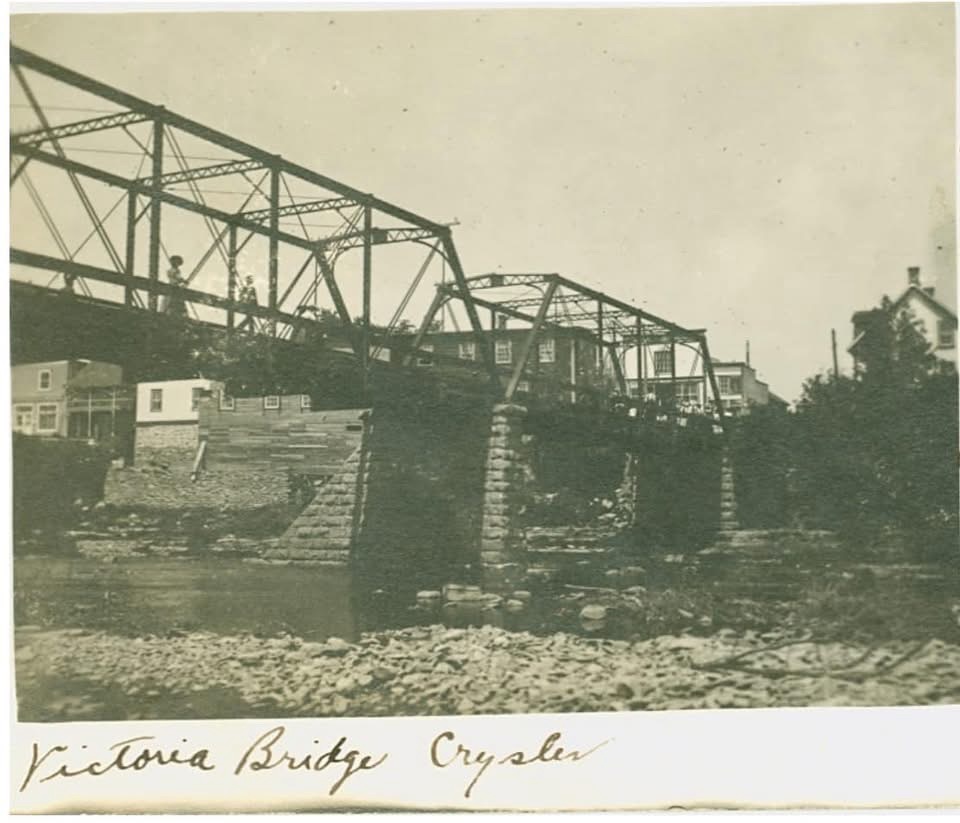
By the turn of the century a new (Coupal) dam had been built and a modern roller mill (Bishop) added to replace the grist mill. It adapted both steam and water power to increase its efficiency. A sash and door manufacturing facility (Braithwaite) was established close by.
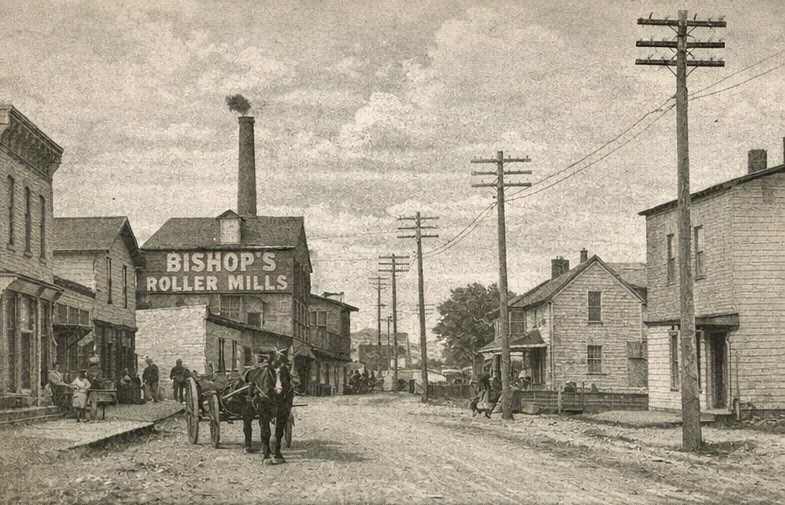
By 1905 there were 650 people living in Crysler.
A new separate school had been built near the Catholic Church on the south side of the river in 1879 to service the growing French speaking Catholic workers. At first, it had one day a week of French language instruction but by 1922 when the Sisters of the Holy Cross took up residence near the church, it became entirely francophone.
The English school remained on the far west end of Charles St. But the class sizes never grew appreciably.
A community of Crysler’s size required a doctor, and by 1905 it had its first resident Doctor Barlow.
Some of the other Charles St. businesses established by then included:
- The Union Bank (1903) – later in 1926, it became the Royal Bank
- The Russell House Hotel (Courville, St. Louis) and close-by livery services (Racine). A telephone exchange was moved there shortly after
- Tinsmith (DuPuis), harness shop (Currie), shoe repair and general stores (3)
- The (Bishop) roller mill installed a generator to provide electricity in 1905.
- A department store (Ranger) included the village’s first library. The store straddled the north bank of the river.
- A clothing store (Leppines) and a millinery store (Lepage) offered fashionable clothing
- A farm implement supply store (LePage) served nearby farms
- Within a few years as automobiles became more prevalent, garages and early car dealerships appeared
At this juncture, the community saw the creation of permanent houses, often made of stone or brick. Many of these original homes were clustered near the mill at the eastern end near the railway station.
This was the peak time for Charles Street — a street built for the industrial age.
But John Pliny Crysler – the settlement builder – never moved to Crysler. He remained in Morrisburg, leaving the village he designed to others. His son, Ralph Crysler, built an impressive brick home at 35 Charles Street in 1903. He passed away in 1906, only three years after taking up residence.
With Ralph’s death, the Crysler family’s direct influence faded. The village the Cryslers built was soon being carried forward by others.
The Francophone Shift: Queen Street Rises (1900–1940)
While Charles Street grew through planning and commercial institutions, Queen Street grew through people and families.
A key early turning point in Crysler history was the construction of the Catholic church in 1870 and its more permanent rebuilding (and renaming) in 1899. Its presence encouraged Francophone settlement and anchored the community as residents moved to Crysler from Montreal or near-by Embrun.
By 1900, Queen Street was alive with French speaking family‑run businesses:
- Benoit’s general store (1903 and 1904)
- Richard’s, then Varin’s Commercial Hotel
- Lepage, then Cuerrier, Varin and Bourbonais butchers
- Dupuis’ blacksmith and harness shop
- Lafleur’s bakery
- Robert brothers’ jewellery store, dance hall, roller rink, and restaurant
These were not speculative ventures. They were family run enterprises whose ownership was passed down through generations.
And these enterprising souls endured the worst the river could throw at them — the horrific floods of 1907, 1935, 1957 and again in 1982 — rebuilding each time.
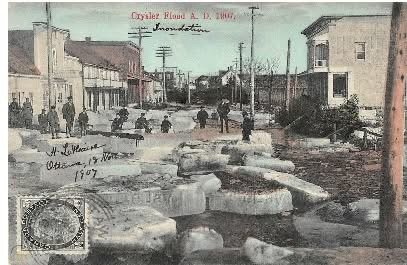
Many francophone residents also began to buy and/or operate businesses on Charles St., initially on the east side near the bridge. This movement marked a significant shift into the previous Charles Street anglophone stronghold.
By mid‑century, Queen Street had become the true heart of the village as Charles’s commercial role faded and it became more a residential street.
In 1957 the railway station, its tracks and its impressive bridge across the river were removed.
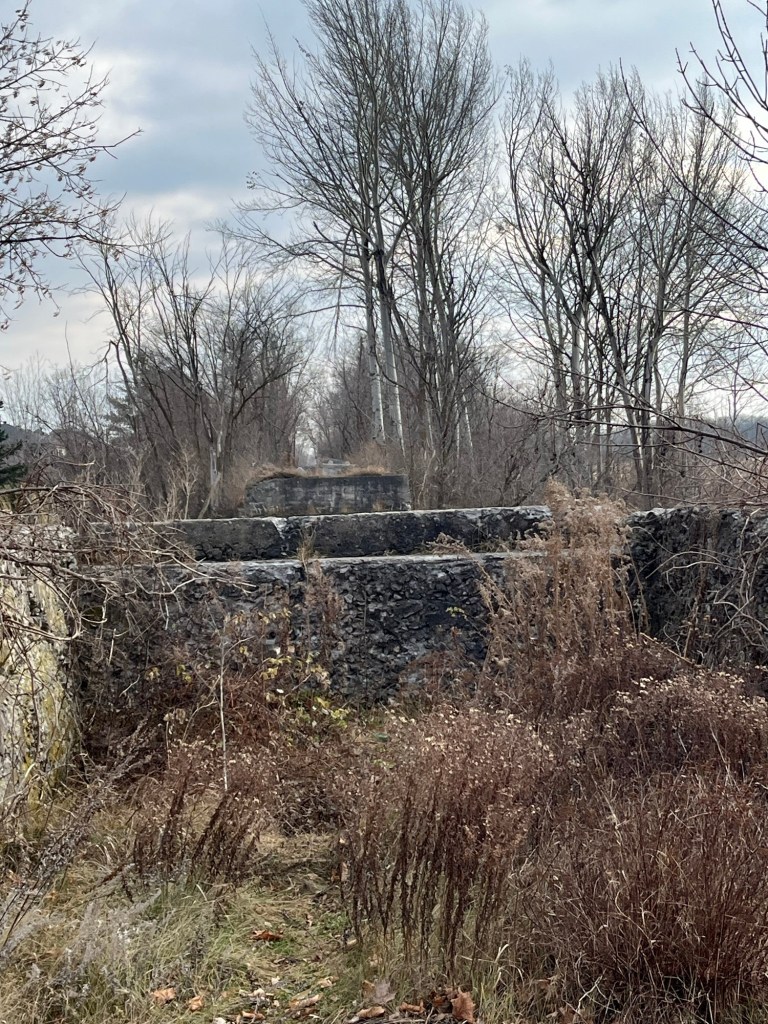
Conversion of the Royal Bank to an apartment in 1974 was the last telling sign of the demise of Charles St. as the commercial centre of Crysler.
The Mid‑20th Century Builders: Lafleur, Patenaude, Bourdeau, Leduc (1940–1980)
Family businesses in Crysler continued to dominate Queen St. even as the economy turned down during the Depression years and the Second World War. While some English-speaking families with strong local roots remained, most of the community was francophone.
Here are some of the businesses that continued to operate during these demanding economic times:
- Armstrong insurance, which eventually passed to Brister’s Insurance Group
- Uriah Wert, and then his son Dick’s shoe store evolved into electrical appliances, tire repairs, an automobile garage and then a car dealership
- Provost cartage, a multi generational business, grew to include gardening supplies and tool rentals
- Richer plumbing saw three generations of family ownership
- Benoit general store passed down ownership through the family for three generations
Beyond these businesses, several names dominated Crysler’s mid‑century identity.
One was Paul Lafleur, a visionary who built an egg‑grading business that grew to include many employees and serviced some of the biggest grocery chains. He started on Charles Street in 1939 using locally raised eggs and grading them for stores in Crysler. Eventually he relocated to Queen Street and as his business kept growing, he purchased the local auto repair business on Queen Street to service his vehicles. In 1945, he acquired the mill and dam on Charles Street for poultry feed milling.
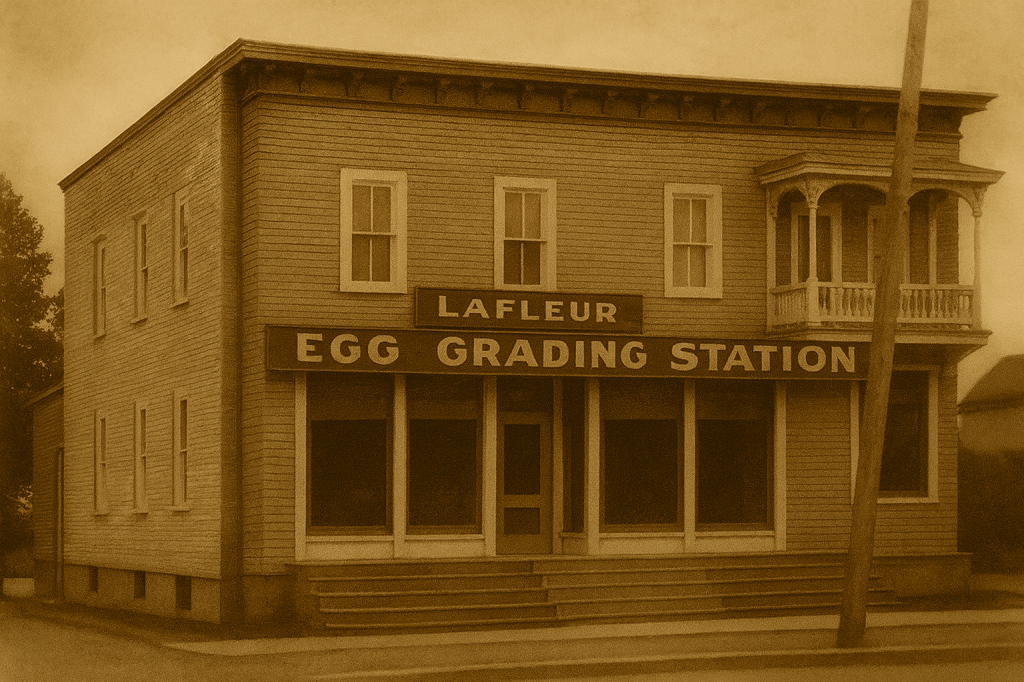
For 50 years Paul Lafleur and his family bridged the two halves of the village — industrial and community as a Crysler business success story.
Rolland Patenaude began working in Dick Wert’s garage on Queen Street. He helped establish a GM automobile dealership which Wert initially offered to sell to him in 1959 but then changed his mind.
Patenaude, a natural businessman with a knack for success, turned around and then bought the cheese factory on Fourth St. that had just burned down. Despite no experience in that type of business, he found a knowledgable partner and successfully ran the cheese factory for ten years before selling its quota and closing the business in 1971.
Another car aficionado was Fernand-Guy Bourdeau who originally worked for Wert and then established his own garage and dealership on Charles St. A community leader, he eventually donated land for the community centre and library on Second St. This gift reshaped the village’s social life.
After the Second World War there was a boom period in automobile growth which Wert, Patenaude and Bourdeau all took advantage of.
At the same time, returning servicemen in the area were looking for meaningful employment to start their families. The post war years became a time of unprecedented growth in the construction industry.
Real Leduc was a cabinet maker who turned a woodworking shop on Mary Street into a major construction centre. At one time employing 70 workers, his firm built homes in Crysler, municipal structures throughout the County and many extensions to the growing local Catholic school. When he retired his sons kept the business going.
These prominent Crysler family representatives kept the community vibrant long after the railway was abandoned and the bank left town.
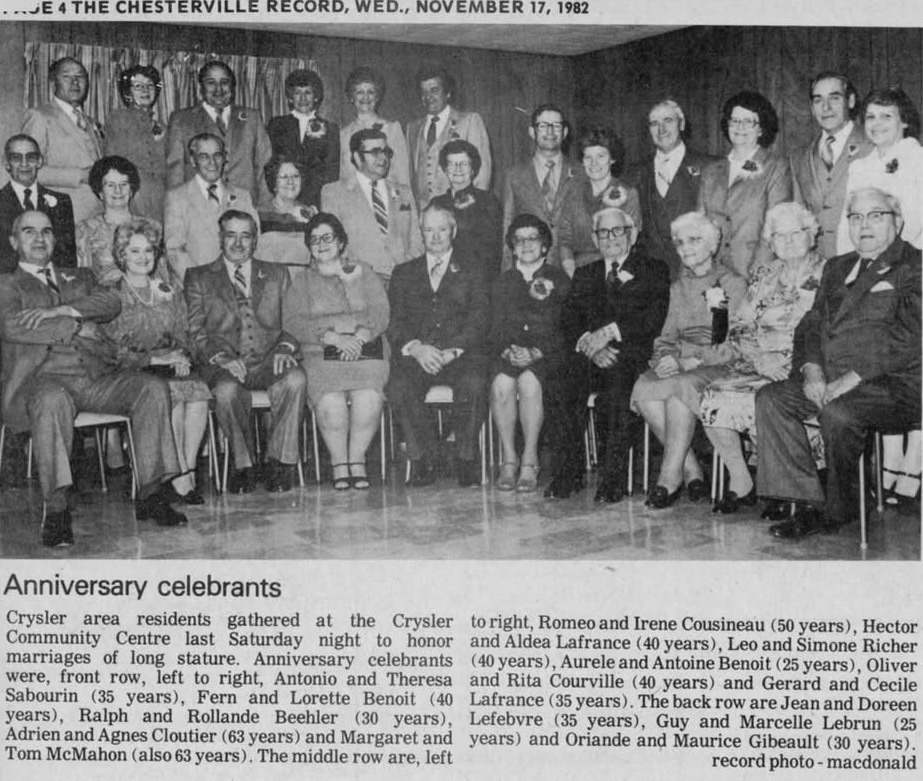
A picture in the Chesterville Record dated 1982 shows many of the families that have lived in the community for many years and contributed to its commercial growth and community development. Its an impressive picture that shows some of the residents celebrating 40 or more years of marriage – and deep roots and attachment to Crysler.
By the 1970s the rural economy was beginning to change. Small farms were merging into larger ones and they looked to services that only the larger, non-local businesses could offer. Local manufacturing declined. Cities offered products at lower prices and with greater variety than the rural community businesses could provide. Automobile dealerships consolidated and focused on volume sales. Regional dealer services replaced village ones.
The children of these stalwart Crysler entrepreneurs inherited businesses that no longer fit the times.
Crysler entered a quieter period.
Despite the economic slowdown, though, behind the scenes, the spirit of community stewardship did not end.
Crysler has long relied on residents who work quietly in the background. They rarely have appeared in the local news, but their efforts have built playgrounds, expanded the community centre, improved recreational facilities, and kept the village moving forward.
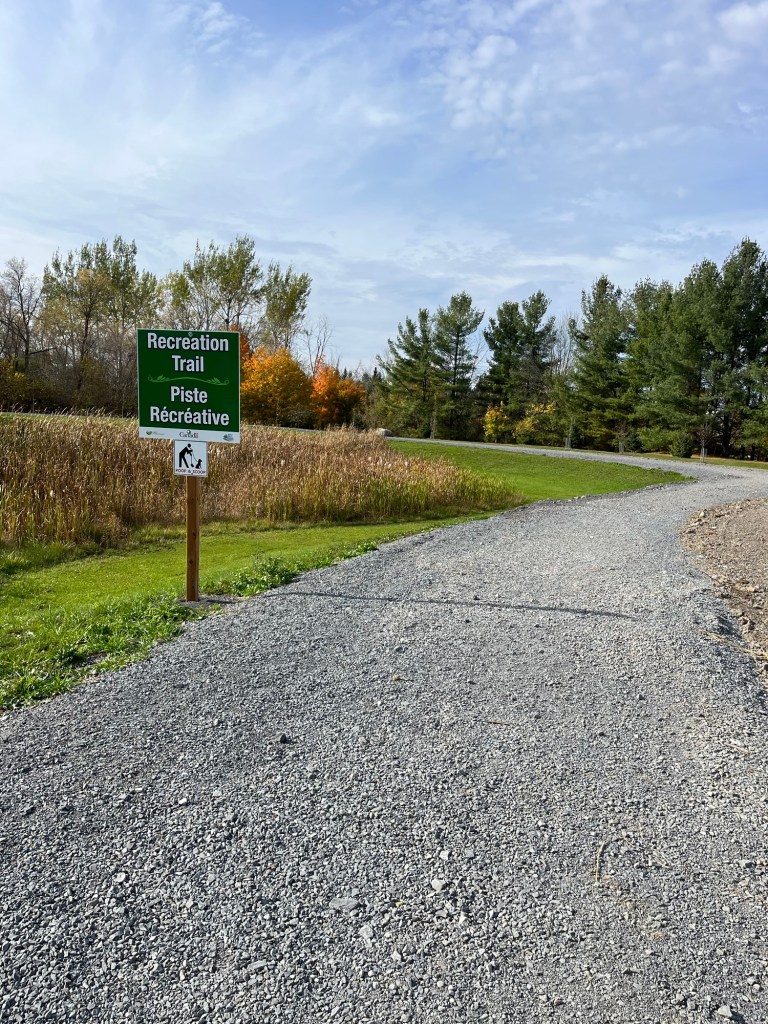
This quiet volunteer culture is one of the reasons why Crysler has continued to sustain its population while other communities in North Stormont have seen a decline.
The Next Crysler: An Urbanite Village (2010–Present)
Something unexpected has started to happen in recent times.
Urban families began arriving — first a trickle, then a wave. Drawn by affordability, space, and community, they began settling in new, small scale subdivision developments on the south and east sides of the community – above the floodplain. They brought children, energy, and a demand for services.
And they were predominantly anglophones.
They found a village with a cultural legacy shaped by francophone families with deep family roots and an amazing spirit of volunteerism.
Crysler had an active community centre ready for revival, a general store that had never closed and a river that no longer flooded after dykes were finally built in the 1980’s.
Crysler was becoming a modern bilingual village, not by erasing its past, but by inheriting it.
The Covid epidemic in 2019 brought a remarkable change to the village. At that time, two local custom home builders – Phillipe Grégoire and Steve Encarnacao of G&E Construction, sensed the opportunity to expand their business into subdivision development in Crysler. They built a new subdivision of 20 homes during this period in the south end of the community.
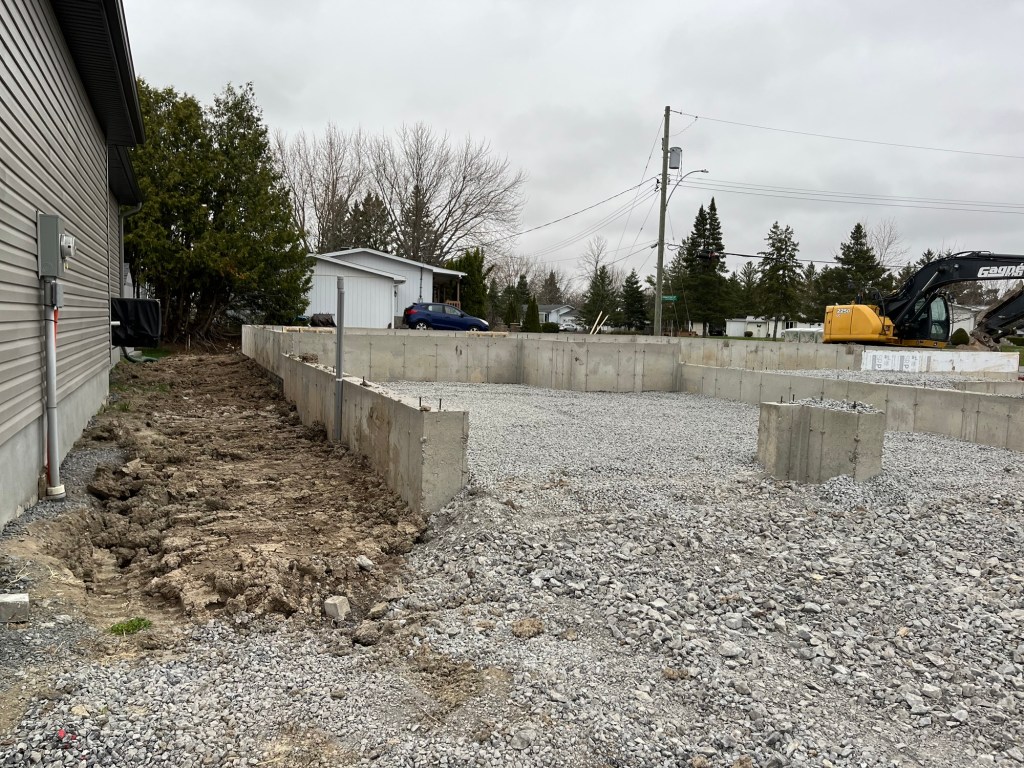
Working from home was the norm doing Covid, and young families opted to move to Crysler to do this in affordable, quality homes offered by G&E. Despite the Covid period supply uncertainty, families were able to take advantage of the availability of these newly constructed homes while house prices skyrocketed in neighbouring Ottawa and housing development ground to a standstill.
Successful completion of this development was the incentive that G&E needed to expand. In 2024 they began offering a phased implementation of 250 homes in a newly planned urban-like development on the north side of the community.
Despite recent back-to-work orders by most urban employers, Crysler has become an attractive commuter village and houses in the new development continue to sell. Recent incentives by the provincial and federal governments have helped to make these new homes even more attractive to young urban families.
Other developers have now also seen an opportunity to meet this new demand for housing and land around Crysler has seen applications to build more housing.
Crysler is rejuvenating itself, this time from urbanites (mostly anglophone) seeking to make this pleasant community with a remarkable history their new home.
Crysler: The Village That Keeps Rejuvenating Itself
Crysler is not just a place.
It is a story of a village with several chapters: one written by history and settlement planners, another by generations of enterprising families, and now, one rediscovered by urban newcomers seeking a comfortable lifestyle with a distinctly wholesome charm.
 MainstreetRob