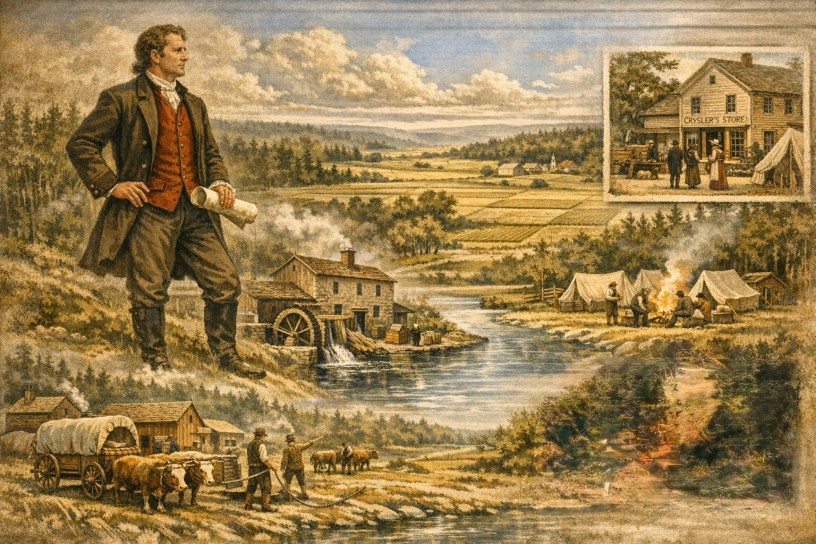
Every village in Eastern Ontario carries its past differently. And founding families have always played an influential role in their evolution. So, what does the future hold?
This is the story of one of those communities – Crysler Ontario. What we see today is the evolution of a long history, one shaped by Loyalist families searching for a new life, by the ambitions of the Crysler family across three generations, and by the shifting cultures that built it first as an English village, then as a francophone community of strong family roots, and now a growing commuter town.
This series follows that historical arc. Each post steps into a different moment in Crysler’s evolution—how the land was settled, who shaped its early growth and development, and how it reinvented itself several times. Taken together, these posts trace the story of a small place that has never stopped changing and never stopped becoming something new.
This post turns to one of the most influential figures to emerge from that Loyalist world: John Crysler, whose ambition and landholdings helped shape the region’s early development.
When Loyalist refugees arrived in Upper Canada after the American Revolution, most struggled simply to survive. A few, however, saw opportunity in the unsettled forests of the Royal Townships. Among them was John Crysler, a man whose ambition, political influence, and land acquisitions shaped not only the early economy of Eastern Ontario but the village that now bears his name.
John Crysler was born in 1768 in Scoharie County in the Mohawk Valley of New York, a region settled by German Palatine families who after resettling in a virtually uninhabited area in the early 1700’s, transformed the land into prosperous farms.
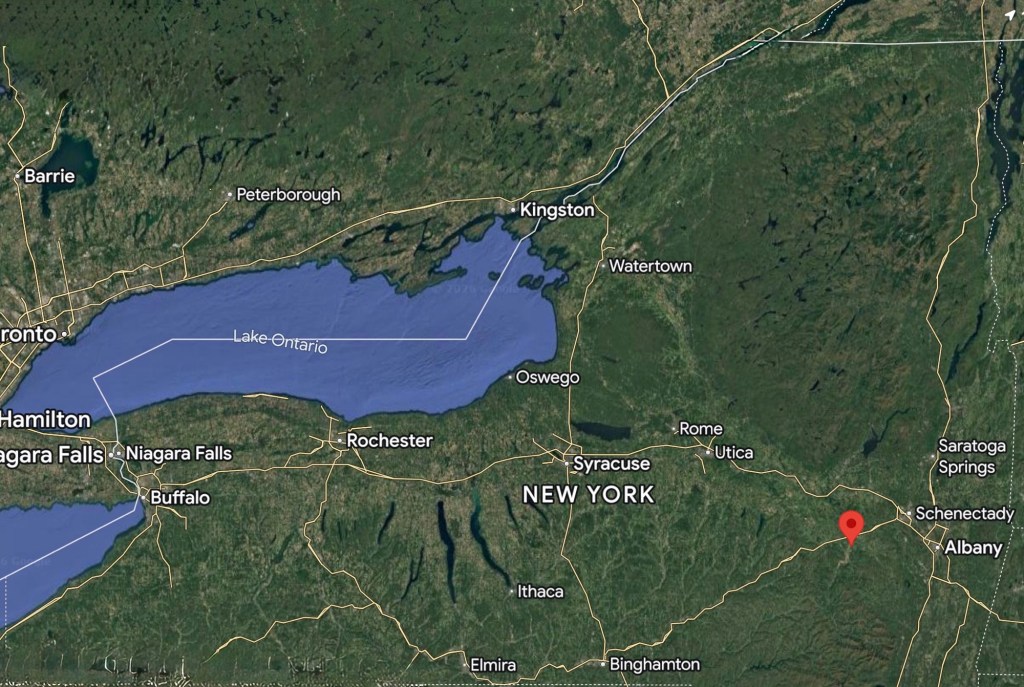
John’s father, Philip Crysler, was a committed British Loyalist. When the American Revolution began in 1786, Philip followed Sir John Johnson in military duty. His brother, Adam, joined Lt. Col. John Butler’s Rangers, a British‑aligned unit composed of regular soldiers, Loyalist volunteers, and Iroquois Confederacy allies under Joseph Brant. Their specialty was surprise attacks, then razing and pillaging farmlands of “rebels”.
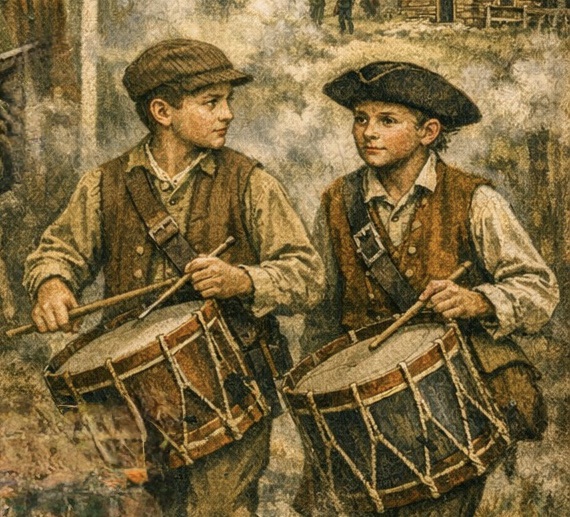
Philip signed up his sons, John (age 10 at the time) and his brother Geronomous (12) to serve as drummers for Butler’s Rangers—mere children participating in a war that would uproot their entire family.
When the British lost the conflict and the Treaty of Paris was signed, the Cryslers could not go back to their extensive farm holdings in New York. Their farms had been confiscated. The family fled west, first to the Niagara region and then across Lake Ontario, then down the St. Lawrence River to Williamsburg Township near present‑day Morrisburg.
As a soldier who fought with the British, Philip received early land grants for his military service, and his sons inherited Loyalist land rights. He and his family settled in the Morrisburg area of Williamsburg Township and began farm life anew.
By the time Philip passed away, sometime around 1795, John Crysler was a prominent citizen in the new region of Canada. By then he had seven children (who would inherit land grants on maturity as children of United Empire Loyalists). John went on to have 20 children (one died at birth) and three wives who unfortunately predeceased him over his 84 years of life.
His oldest son, John Pliny Crysler would go on to enhance the legacy of the Crysler family and leave another indelible mark on the history of Eastern Ontario.
By the early 1800’s, John Crysler had established himself as a rising figure in Upper Canada’s frontier economy. He had opened a general store, secured tavern licenses, and built commercial relationships with suppliers in Montreal. These connections gave him access to high‑value goods—liquor, tobacco, salt—that were scarce in the rural settlements. Those same connections would later allow him to expand into his next formidable business venture.
At that time, forests of Eastern Ontario were rich with white pine, prized by the British for shipbuilding and construction. John Crysler recognized that timber was a powerful commodity for those willing to find and harvest it, and he began looking for land he could purchase to exploit those stands of virgin white pine forests.
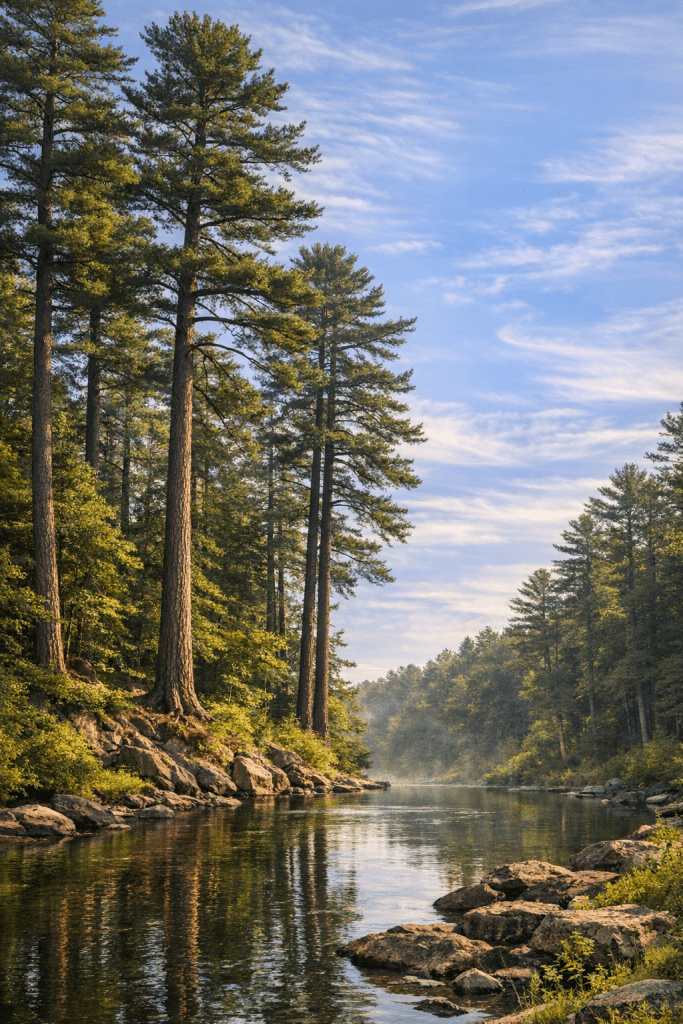
Land along the Nation River and its tributaries was perfectly suited for growing these valuable species. There were white pine trees 100-150 feet tall in that area.
Crysler used his Loyalist land rights and began purchasing the “tickets” of other Loyalists, intent on assembling large tracts of forested land.
With this business strategy, he was no longer just a storekeeper. He became a landowner, a mill operator, and as a timber exporter he expanded his business and political influence in the region. He realized the value of what economists might call vertical integration. To harvest the timber, he built sawmills along rivers, using waterpower to process lumber and transport it down rivers to the markets in Montreal. When the land was cleared for crops, grist mills were constructed to process the grain.
Crysler expanded his influence by entering politics in the new province of Upper Canada. He was elected to the House of Assembly for Dundas, initially in 1804. And he served as an elected member in later periods for more than 16 years altogether. In 1806 he was appointed as justice of the peace and held that position for almost 40 years. Through his business and political connections, John Crysler became an economic powerhouse in the new land of Upper Canada.
Between 1806 and 1811, John Crysler undertook one of the most ambitious land‑acquisition campaigns in early Upper Canada history.
Focusing on the dominant river in Eastern Ontario – the Nation River – he began assembling land in Mountain Township in a sparsely populated area about 6km north of South Mountain. The Nation River there was a northern tributary of what eventually became the larger South Nation River. His timbered land was upstream from two small communities, Van Camps Mills and Inkerman.
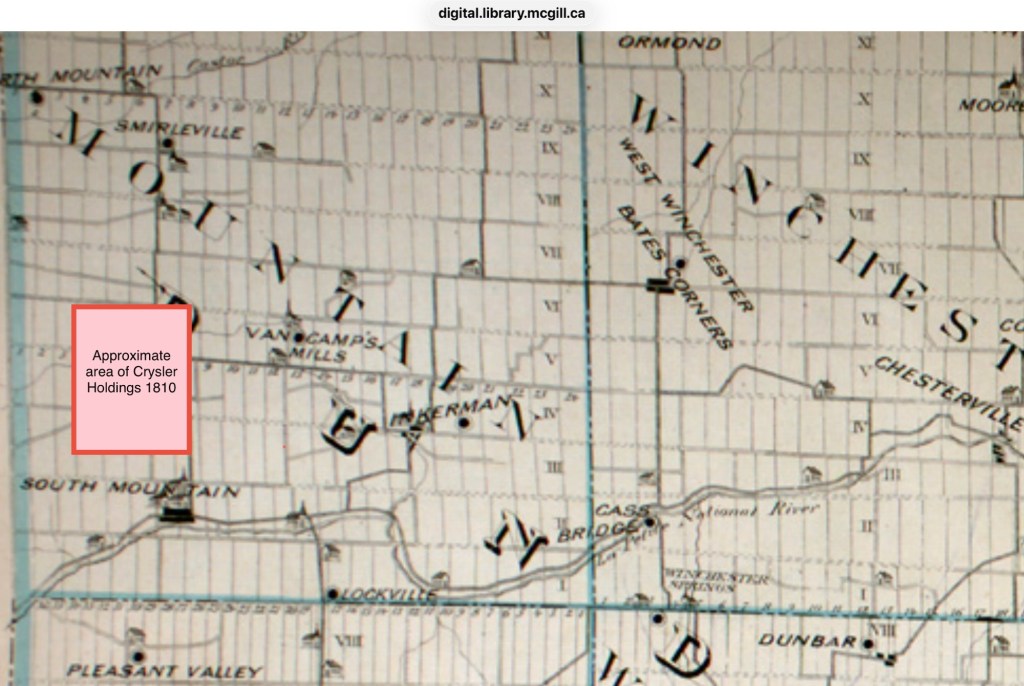
There are unfortunately very few easily identifiable records of how much land he purchased or obtained in Mountain Township, but some believe it could have been as much as 2,000 – 2500** acres.
In 1810 he sold 2,500** acres of this land to a prominent land developer in Montreal – John Richardson – whose business activities rivalled those of the North West Company at the time. Richardson in turn eventually sold much of the land after the timber era began to decline. The McIntyre and Crawford families appear to be the prime buyers of the former Richardson / Crysler property.
Crysler’s business mantra at that time was simple: the more acreage you had of white pine timber, the more timber rights you would receive from the British government. Timber rights not only increased the value of the property and made the owner a favoured supplier to the British, but it made him very wealthy.
Giving up that 2,500 acres (or more) of land in Mountain Township might seem foolish for someone else, but Crysler saw more advantages in land east of there, in an area of Finch Township close to the South Nation River.
As early as 1806 he began amassing land in Finch Township. By 1811 he owned as much as 2,300 acres in that area.
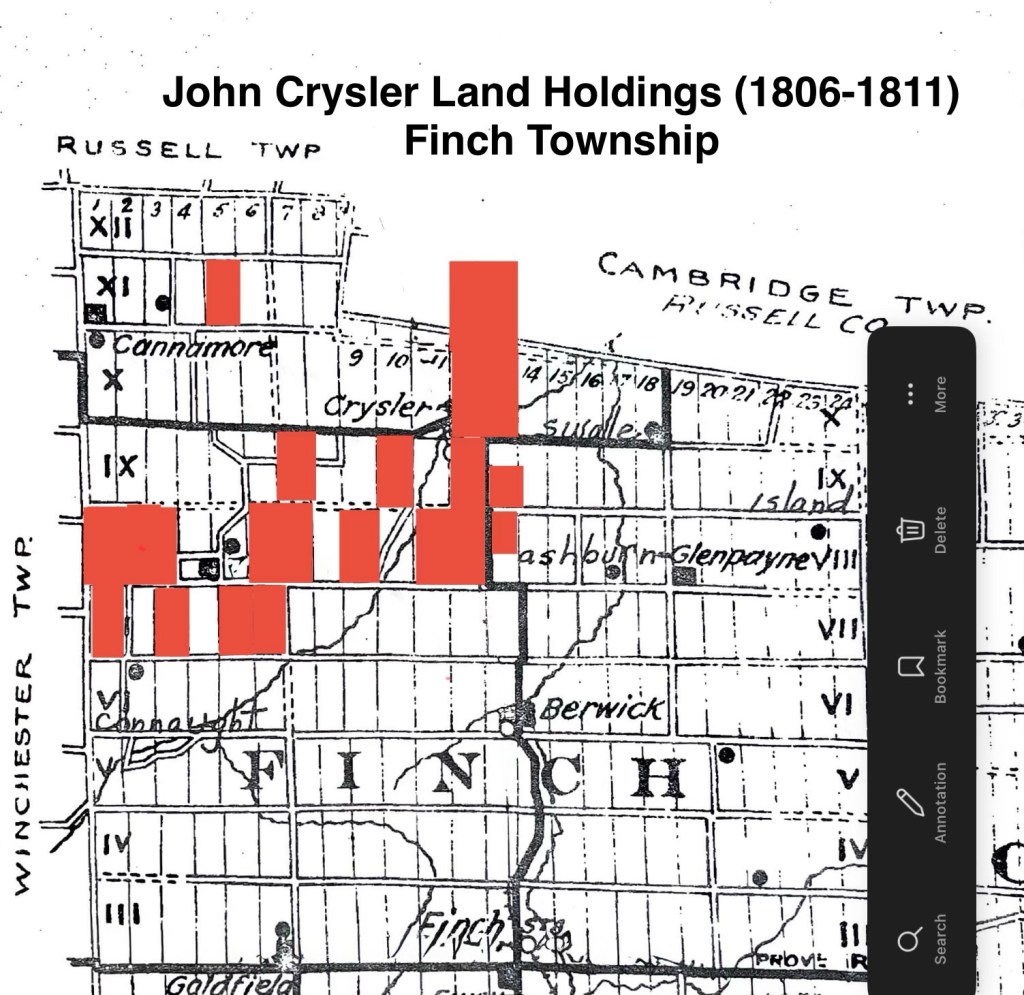
Part of these holdings included land in the present-day village of Crysler, and to the west near a small community called Cahore. At that time, though, he was not in the settlement business, he was in the timber business.
Consider how lucrative this timber business was. In Upper Canada in 1811, uncleared land was often granted free to Loyalists (assuming they would inhabit it) or it might be sold for 5-10 shillings per acre. Timber rich land, if white pine stands were on it, would sell for 1-2 British pounds per acre. In today’s dollars, those 2,300 acres would be worth between $250,000 and $500,000, a premium of four times other uncleared lands. But the real premium was in the timber itself which would be worth anywhere from $4.5 million to $11.5 million in today’s dollars.
Why was this land so valuable? The British had an insatiable appetite for Eastern Ontario white pine as their ships required tall, straight, knot-free masts. And the Napoleonic Wars, often fought with naval battles, began in 1803 and lasted until 1815. During this time the British were pressured to requisition more and more timber for their ships.
Finch Township offered significant advantages over other Royal Townships. Timber harvested along the South Nation River could be rafted to the Ottawa River and then on to Montreal more quickly than from those areas like Mountain Township which were upstream. This river transport route could even rival timber transport originating west and north of Ottawa that would also be floated along the Ottawa River to Montreal. Close-by Russell lacked such easy transport. The British paid well for these trees and in 1808 Crysler obtained a highly valuable license to provide white pine stock to the British. With this license he undoubtedly began to lease timber rights from properties he did not own.
This was a boom time for timber providers.
Integrating the sawmill operation was a natural step to increased production and greater economic returns. His first land purchase in the Crysler area in 1806 became a site for a sawmill and later a grist mill on the South Nation River. That timber milling site remained prominent in the village of Crysler’s visual history until the early 1950’s.
Crysler’s timber land expansion plans were halted in 1812 as the Americans once again challenged his Loyalist roots.
At the time they were threatening to annex Canada. With the Napoleonic Wars raging, and French Quebec sentiment bubbling up against British colonial rule, it seemed like an opportune time for the Americans to capture Montreal, and with it, the rest of Canada.
John Crysler had been a Lieutenant in the Dundas Militia and with the Americans on Upper Canada’s doorstep he began military campaigning once again in support of the British. He was promoted to Captain in 1813.
That year he was involved, arguably, in one of the most important battles in the history of Canada. Crysler offered his farmland site and house in Morrisburg (now under the St. Lawrence Seaway) to the British forces led by Lt. Col. Morrison who strategically defeated the American army despite being significantly outnumbered. Crysler’s house served as the command centre and later as a hospital for wounded soldiers. Crysler himself was dispatched to Montreal to advise of the American defeat.
That battle, now referred to as the Battle of Crysler’s Farm – is commemorated today at a location just west of modern-day Upper Canada Village and just east of Morrisburg, Ontario. (The original farm was flooded in the creation of the St. Lawrence Seaway in 1957). During the summer, many history activists re-enact that famous battle.
When the war ended in 1814, Crysler returned to his business interests but shortly thereafter the Napoleonic Wars ended. Crysler’s business with the British navy declined significantly at that point.
Some historians claim that, to a fault, he spent lavishly on entertaining. Others noted that he sold lands that were not as they had been advertised, and some deeds were challenged in courts. On other occasions his employees were found guilty of taking timber from church lands instead of his own. On several occasions he was found to be in financial default and could not pay.
Sadly, in his later years he had to sell off his less valuable properties. The formidable Crysler family banner, though, was picked up by his son, John Pliny Crysler, who had risen to community prominence in the manner of his famous father.
A longstanding British patriot, John Crysler, aged 70, accompanied by his son John Pliny, successfully lead his reservist forces into battle against the Americans again at the Battle of the Windmills near Prescott in 1838. For his efforts he was promoted to Lt. Col.
He moved from Morrisburg to a house in Crysler, Ontario in Finch Township in 1848. He died 4 years later and was buried in St. John’s Anglican Cemetery on the banks of the South Nation River.
John Crysler was a settlement founder. He was a timber man and prominent businessman in the early 1800’s. (Surprisingly perhaps, despite his storied name in Canadian history, there are no known pictures of him).
His son, John Pliny, became the settlement builder. The man who helped build villages and encouraged others to live and work in those communities.
The next article in our series will highlight how John Pliny and his son John Ralph Wesley Crysler (Ralph) contributed to the growth of Eastern Ontario communities, and notably to the village that carries the Crysler name today.
**An earlier version of this post assumed that lots in Mountain and Finch Township were 200 acres each. This should be corrected to 100 acres as these later surveyed areas of the Royal Townships had lots of the smaller size.
 MainstreetRob