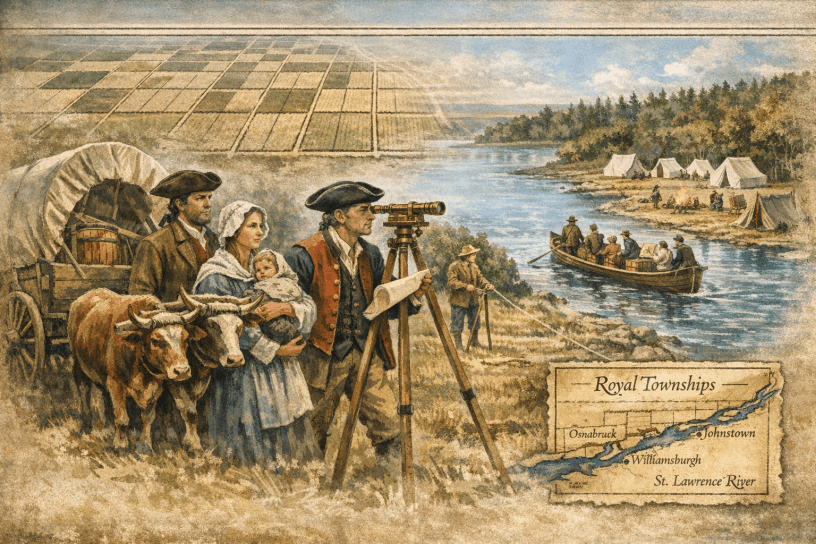
This is the first post in a series that follows a historical arc around the village of Crysler, Ontario.
Each post steps into a different moment in Crysler’s evolution—how the land was settled, who shaped its early growth and development, and how it reinvented itself several times.
Taken together, these posts trace the story of a small place that has never stopped changing and never stopped becoming something new.
This story of Crysler, Ontario does not begin with its mills and its general stores, or with the founding Crysler family itself. It begins decades earlier, during the conflict of the American Revolution, when thousands of displaced families who had supported the British against the American “revolutionaries” fled to Canada seeking land, stability, and a new beginning.
The arrival of these United Empire Loyalists (who were honoured with the designation U.E.), and the political decisions that followed, shaped the landscape, the land system, and the early communities of Eastern Ontario, including what would later become the village of Crysler.
It was a remarkable time in Canadian history, so important that Statistics Canada estimates that twenty per cent of modern-day Canadians can trace their genealogical roots to these Loyalist families.
Upheaval, New Land, New Hope
When the American Revolution began in 1776, many families in the Thirteen Colonies (now part of the United States) chose to remain loyal to the British Crown and fought for several years against against the “revolutionaries”.
Their loyalty to Britain came at a cost, though. Neighbours fought against neighbours. Houses were razed. Crops were burned. People and livestock were killed. Families were scattered. The carnage continued for six years (and even for many years thereafter as the Americans sought to annex Canada to their new country).
They were a diverse cultural group, these Loyalists. Some were of German heritage. Some had Scottish and Irish ancestry. Many had carved out prosperous homesteads in New York and Pennsylvania. But all were English-speaking American settlers. Their stubborn allegiance to Britain, their strong cultural backgrounds and their mass emigration from America left an indelible mark on the settlement of Eastern Ontario.
Fifty thousand Loyalists emigrated to Canada after 1783 when the war officially ended.
Ten thousand came to Eastern Ontario.
Another thirty thousand went to the Maritimes, principally New Brunswick.
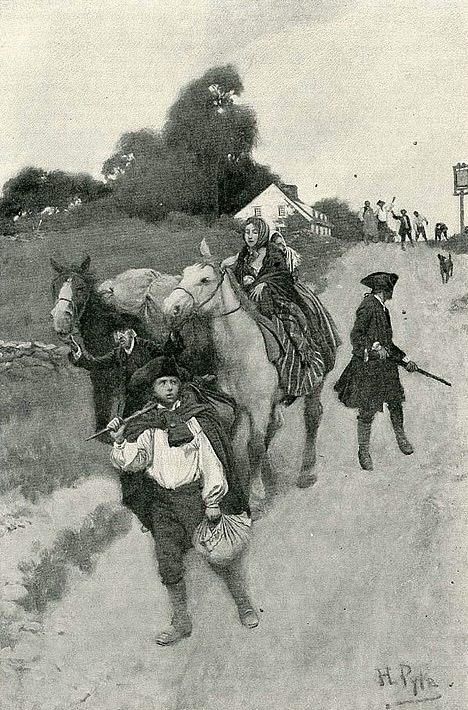
The influx put considerable pressure on the British to change the political system in Canada. Britain responded by creating a new political and geographic homeland for the Loyalists in Canada.
They divided British Quebec into Upper Canada (present-day Ontario) and Lower Canada (Quebec). They offered the Loyalists land grants and provisions to help them start a new homestead.
In Upper Canada they adopted a “freehold” land tenure system, modelled on the system they had introduced in the Maritimes, and comparable to that in the former American Colonies where the Loyalists had come from. There would be no feudal obligations. Land ownership in the new province of Upper Canada would be different from the seigneury system that characterized Lower Canada.
Land Grants for Eastern Ontario Settlers
With the need to prepare for wide scale settlement, the Surveyor of Lands for Quebec was instructed to survey lands for the new settlers.
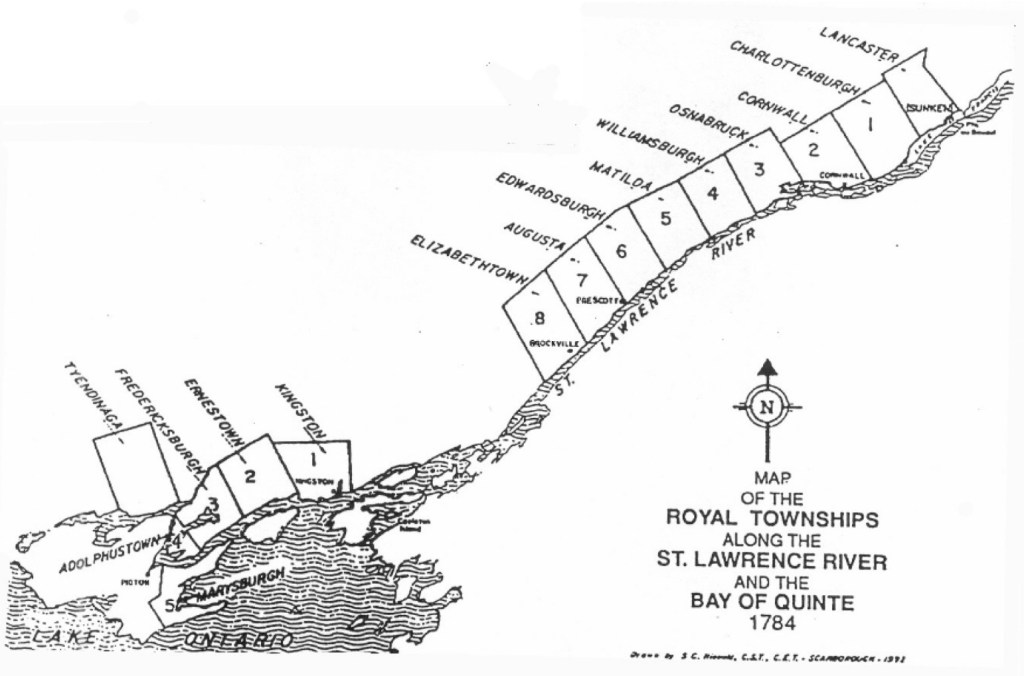
The Royal Townships were created in 1784 and laid out along the St. Lawrence River, initially for disbanded soldiers of two British regiments: The King’s Royal Regiment of New York (KRRNY), and the Royal Highland Emigrants (84th Regiment). The eastern-most Royal Townships formed the earliest organized Loyalist settlements in what later became Stormont, Dundas, and Glengarry County.
Surveyors laid out settlement lots in rectangular grids. Most were 200-acre parcels (approximately 1 ¼ miles long by ¼ miles wide) running parallel to the river. The short sides of these lot rectangles ran parallel to the St. Lawrence River and separated Concessions, and the long sides were designed to allow for road allowances. This rectangular pattern is quite visible today in the lot pattern of Eastern Ontario.
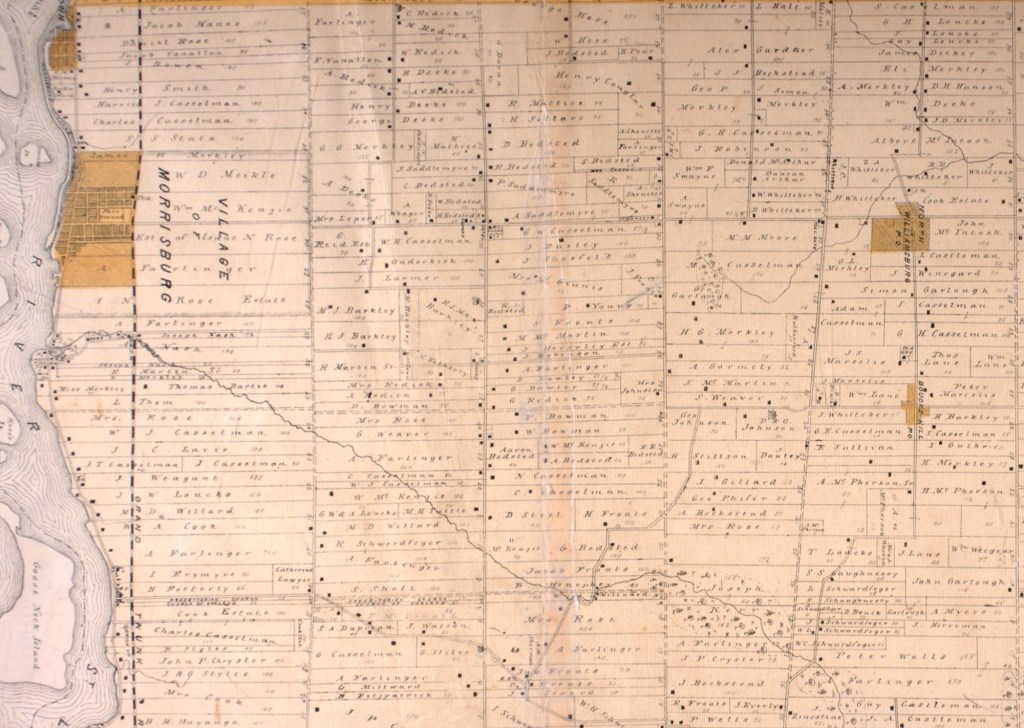
Concessions Parallel the St. Lawrence River (left)
The land assignment and settlement process was a tightly organized military-style operation. Military soldiers (like Philip Crysler of the King’s Royal Regiment) were offered land first, for settlement to begin as early as September 1784. (Well ahead of non-Royal military Loyalists).
Land Boards were set up in 1789 to decide who else would receive land and in what locations.
For those in Eastern Ontario, the settlers initially got together at a location referred to as Johnstown (near Prescott). Most had arrived from a hosting location in Montreal before journeying for 10-12 days up the St. Lawrence to this site. Others came from the Niagara region. Johnstown became the administrative capital of Upper Canada since it was protected by nearby forts and had calmer waters.
At Johnstown, the Loyalist settlers waited for the surveyors to finish their work and then they were guided to their new property.
Many Loyalist settlers arrived at their designated properties to find dense forest, few roads, and little support. Supplies were scarce, as the British had seriously underestimated the number of refugees. Each settler was given a tent, an ax, some seeds, and some blankets. Certainly, it was not a sufficient storehouse of supplies necessary to face the cold winters.
Some sold or traded their land assignment “tickets;” others abandoned their lots entirely, leaving them to revert to the Crown.
Still, many Loyalists persevered. Their names—Crysler, Johnston, Empey, Currie, Stewart, McMillan, MacDonell, McLean, Ault, Casselman—appear repeatedly in early land records across the Royal Townships. Many of these original families formed the backbone of early settlement in what would later become the Crysler area.
The Crysler Family
Among the most influential Loyalist families in Eastern Ontario were the Cryslers.
Loyalist Philip Crysler (also spelled Krausler, Kruessler, or Greisler) had come from a remarkable, enterprising family. He was closely allied with and brought up among the Iroquois Confederacy natives in his home area of Scoharie County, in northern New York. At the time, Scoharie was considered the “wilds” of New York.
Philip’s parents had emigrated from Germany with 3,200 others in 1710. These were the original Palatine Germans in America*. By the 1740’s, Philip’s father and other Palatine Germans had turned their Mohawk Valley homesteads into prosperous agricultural lands, and the Crysler estate was a large one.
When the Revolutionary Wars broke out, the choice to support the British who had given the family this new homeland was easy. Philip, his brothers, and many others chose the British side and took up arms against the “revolutionaries”.
Philip’s older brother, Adam, is legendary (and in some cases reviled) as a fighter for the British military cause. He fought for many years with Butler’s Rangers and Col. John Johnson (later Sir John Johnson).
Philip himself joined Adam’s British military group and led a small unit. Lt. Col. John Butler’s Rangers were a brave, dedicated and sometimes ferociously cruel quasi-military group composed of British full-time soldiers, loyal volunteers and locally resident Iroquois (Haudenosaunee) natives led by Capt. Joseph Brant. Philip enlisted his two young sons John (initially 10 years of age), and Geronomous (12) to serve as drummers for Butler’s Rangers.
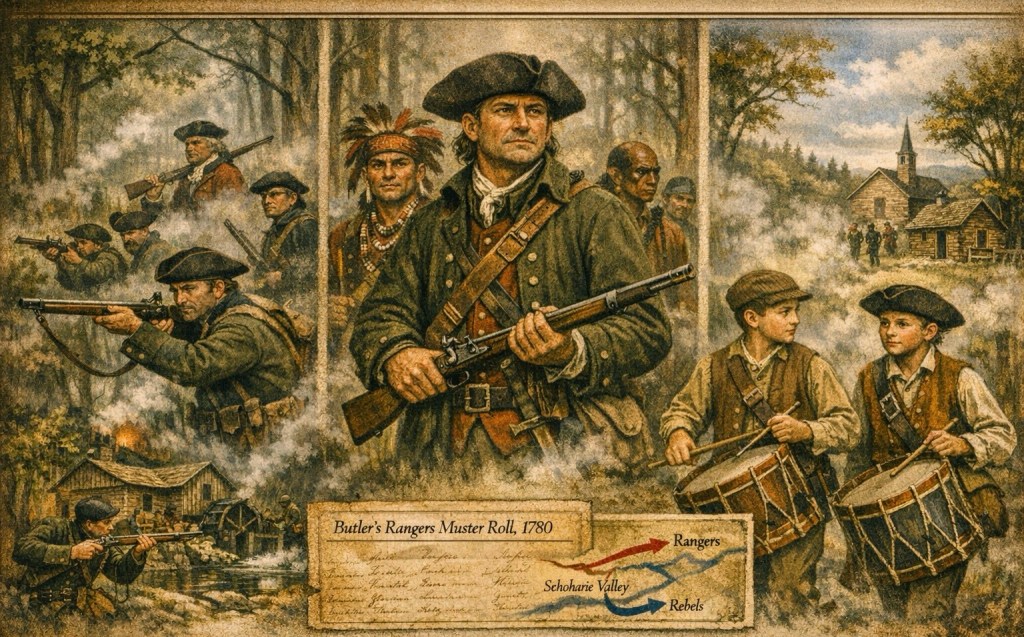
When the war ended and the Treaty of Paris confirmed the British defeat, the Crysler family lands in New York were confiscated. Like many Loyalists, the Cryslers fled to Canada, first to the Niagara region and then to Williamsburg Township near present-day Morrisburg.
Because of Philip’s military service, he received early land patents before the Land Boards were set up to assign land grants to other Loyalists. His sons inherited Loyalist land rights as well.
By the time Philip died around 1795, his farm and holdings were well established. His son, John Crysler, who was 27 at that time, had already emerged as a successful businessman—one whose ambitions would eventually shape the settlement patterns of Eastern Ontario and the history of the village of Crysler.
This is where the next chapter begins: how John Crysler amassed thousands of acres and became one of the most influential figures in early Upper Canada.
- The story of the Palatines is a very complex one. For an early Canadian perspective on their immigration to the Americas it is worthwhile reading the historical account written in 1905 by J. Smyth Carter in the book “The Story of Dundas: being a History of Dundas County from 1784 to 1904”. https://archive.org/details/storyofdundasbei00cartuoft/page/206/mode/2up
 MainstreetRob