Newington – Long-Standing Host of an Important Agricultural Fair
A few years ago, we attended the Newington Fair, which is advertised as one of Ontario’s oldest rural agricultural fairs. There were lots of farm competitions although the number of contestants seemed small and often were within families. There was a food pavilion with blue ribbon pies and other baked goods, flower arrangements and sewing and crocheting masterpieces – but not very many. There were a few rides for young children, mostly inflatable, but not the kind you see at the big exhibitions. The kids were happy to ride on the ponies, though, even if it was within a small circle.
While others were enjoying themselves, we left with a feeling of mild disappointment, as if this Fair was no longer the major event it had been in the past. What we realized later was that this Fair was more than just entertainment. It was the fabric of rural Ontario that has been going on for almost 200 years. It was a tradition of what rural life is all about.
The Stormont County Fair
The Stormont County Fair in Newington is a tradition that goes back for many years. The first Fair probably convened about 1862 when the settlement was still small. Perhaps, like nearby Avonmore, livestock and Fair activities filled Newington’s Main Street. There are no formal records of when the Fair began, but there is reference to it as early as 1867. Exhibits for that Fair were originally presented at the local (later McAvoy) hotel. Some years later the current location at the end of Elm Street became the permanent site for the Stormont County Fair. By 1926 the fairgrounds had expanded and there was a large half-mile racetrack complete with a grandstand, a dance pavilion, a dining lounge and several buildings for livestock and other exhibits.
Escape from Prohibition
During the temperance period, this Fair was probably the only place that you could get alcoholic drinks in a public place. (Prohibition in Newington lasted from 1903 until sometime after 1927). Fair attendees would come on the train from Cornwall and other regional locations, or even from Ottawa. It was a grand event, although during that period, the Women’s Auxiliary might differ!
Today’s Fair is no longer a grand event, but it is still a focal point of interest for those on neighbouring farms. It continues to symbolize Newington’s long-term role as the centre of a rich agricultural area.
Newington Today
The community itself is resilient, but its population has declined over time to its current population of about 220. At its peak, Newington had about 350-400 people. But during the last 60 years, Newington has seen the loss of many small shops including a once-prosperous IGA grocery store, and a Bank of Montreal which, many years before, had taken over the Sterling Bank. That first bank, built in 1909, was a bellwether of village prosperity. The sawmills, grist mills and cheese factories have all disappeared now.
At one time Newington had five churches within the village boundaries, and attendance kept the pews filled. Today it has one. And the former United Church now sits empty on Main Street.
Like so many eastern Ontario villages, Newington began as a hearty early settlement, obtained prosperity, consolidated, and then took on quiet stability.
Newington’s History
In looking at the history of this village, it is really a repeated story of many rural villages in Eastern Ontario. While the players may be different, as they say, “the plot remains the same.”
Still, Newington’s history is an interesting one and an excellent study of the prominence and later decline of rural villages.
First Settlement
The first settlers to Newington lived in an area just north of the current Main Street and slightly west of the intersection with County Road 12. On maps as early as 1850, there were six settlers in Newington. The area around that early Newington settlement was not the rich farmland it is today, rather it was covered with bush and trees. Those hardy settlers had to clear the land to make way for their homes, barns, silos, and fields. They scrimped out a living on the land, far from sources of basic supplies, but persisted, and eventually their efforts helped the area to grow and prosper.
By 1862 there was a bake shop on modern day Main Street and a General Store (Rupert’s) across the street on what is now Fairground Drive. A small school was built on Main Street near the General Store.
A Post Office and a Name
Jacob Baker was one of those early first settlers in the Newington area. In 1862 he set up a post office in his general store just to the south on County Road 12. While there may be some controversy as to whether he first named the village “Newington,” or whether it was a doctor in the area, the village has existed and held that name for more than 160 years.
It did not take too long for the area to begin to develop after it gained post office status. The story of a transition from settlement to village after getting a post office is often repeated in the history of villages in Eastern Ontario.
Four Village Blocks

Early Maps of Newington
Source: Newington – From Old to New
In 1868, John Bruce carefully surveyed the village. This well-organized village structure ensured ownership was clearly defined.
Ninety-two similarly sized lots with intersecting roads created four village blocks. In the south, Main Street divided Concession 7 and 8 and connected to Country Road 12. Cedar Street was the village’s northern border. East Street (later Main Street North and County Road 14) was the eastern boundary, and Elm Street (later Fairground Drive) was on the west. Ash Street, running north-south, bisected the community, as did Mill Street which ran east-west. A small creek wound its way from southeast to northwest through some of those lots and was used for early mills. This village framework still characterizes Newington today.
The Stagecoaches
Post office presence meant a regular stagecoach service capable of bringing supplies and news to the community. The stagecoach ran from Dickinson’s Landing on the St. Lawrence River in the south, through Lunenburg to Newington, then on to Finch in the west and then north to Crysler. Roads in those days were narrow, dirt covered and often potted and were exceedingly difficult to traverse in wet weather and winter. In the winter, deliveries were often by sleigh.
The McAvoy Hotel
Every village post office stop usually required a hotel to cater to passengers and coach needs as the stagecoach made its way along the rural roads that linked communities. Newington’s first hotel was built about 1875, a development that began the noticeable growth of the community.
By 1906 that hotel had changed ownership twice. Enterprising John McAvoy bought the hotel (for the grand sum of $1500) and not only gave the hotel his name but offered added business ventures such as livery service (the historical equivalent to modern day taxi service) and undertaker duties. The hotel provided food and drink (mindful of prohibition rules, of course), rooms for travelling sales folk to show their wares, concert facilities for entertainers to conduct music or plays, and areas for dancing. The hotel was an important part of the growing community. (The Newington fire hall now sits on the site of the former McAvoy hotel.)
A Booming Rural Community
By the turn of the century, Newington had a furniture store, blacksmiths, a butcher, a carriage repair shop, a cheese and butter merchant, a doctor, four general stores, two hotels, a saw mill and cheese box manufacturer, a saw and planing mill, a tinware merchant, and by 1905, a bank. It had become a commercial hub for the growing agricultural region around it. People came to Newington for farm supplies, food, cloth, flour, and mostly, to hear the latest news.
Newington Churches
The residents of Newington were hard workers, but they were also a pious lot. Churches were the social anchors of the community. They provided a place for worship, friendship, social teas and community suppers, meetings, and ceremonies for deaths, marriages, and christenings, all of which kept the community tightly entwined within the purview of the church and its community-respected minister or pastor.
The construction of churches mushroomed in the latter part of the 19th century. The first church built was the Wesleyan Methodist Church, which became known in the community as the “white church.” It was built in 1879 and served the community until 1961 when it was demolished. During its many years of service to the community, its bell provided a call to worship, a fire alarm, and a school timer. That bell still holds a prominent position in the Newington to this day, sitting in front of the now unoccupied “brick” United Church across the street on Main Street.
In 1881, the Anglicans built a church at the corner of Ash and Cedar in the northern part of Newington, and next to it, a rectory. Residents had previously journeyed several miles east of Newington for church services and were quite supportive of building a church closer to home. That church still exists in the community but no longer serves a congregation or offers church services. It has become a unique privately-owned storage building with a garage door, but an obvious church-like look about it.
Also in 1881, the Episcopalian Methodists moved an existing church from a site several miles south of Newington to a location in what is now the corner of Ash and Main Street. (The two Methodist congregations, which included this church and the “white” church, were united in 1886).
Originally, Presbyterian followers journeyed some distance south of Newington for services, but in 1885 they began worshipping in the Baptist church on Ash Street. The impressive “brick” Presbyterian church, by far the tallest structure in Newington, was built some ten years later on Main Street between the McAvoy Hotel and the Jardine General Store and post office.
When the Methodists merged with the Presbyterians in 1925 to become the United Church of Canada, the Methodist “white” Church no longer was the primary place of worship for Methodists in Newington. Even after the church union, though, that small church remained prominent, providing a Sunday school for children, and other meeting services for residents of the community.
The Forbes Legacy
Two wealthy brothers from Montreal, the Forbes, built a general store on Main Street in 1881, and a young fellow by the name of G.F. Jardine worked there. He bought the General Store in 1888 from owner George Forbes and turned it into a bustling business. He and later generations of Jardines ran the General Store and the post office as postmasters for many years, but the Forbes brothers kept an interest in Newington. They lived there in the winter and spent the summers in Montreal, and their friendship with the Jardines assured that their Newington General Store would get the best products from Montreal at the most reasonable prices.
Just at the turn of the century, George Forbes donated the family home to Newington to become a library. The Forbes library grew in importance in the community, for it was the first source of more than 900 books that rural residents could borrow. There was sufficient room in the house/building for use as a small theatre too, for such things as travelling medicine shows, children’s plays, and when times were tough the Forbes library served as an interim school. And there were several fires that ravaged many of the school buildings in Newington over the years.
Stormont Dundas and Glengarry County eventually took over and ran the library for many years. In 2002 it was moved to the Lost Villages Museum near Cornwall.
The Railway Era
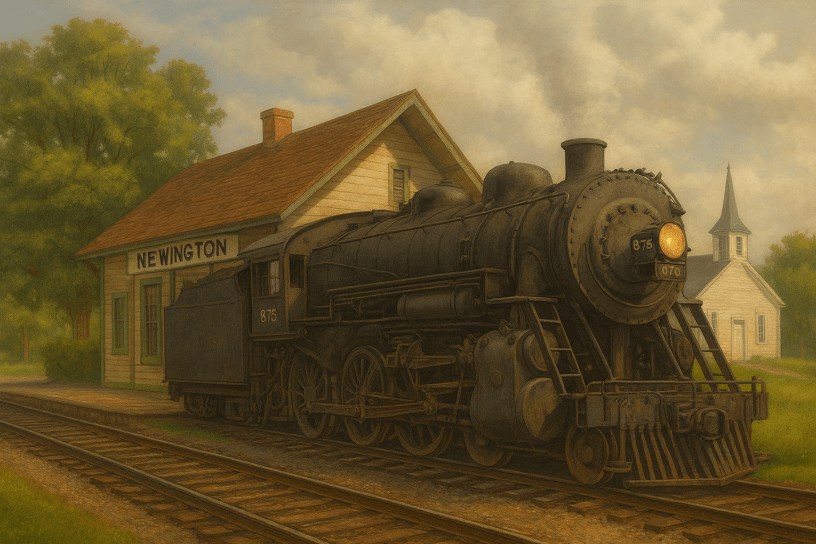
The Ottawa-New York and Adirondack railway (later the New York Central Railway) first passed through Newington in 1897. A single level station was built in the northeast part of the village (at the corner of Cedar and Main Street North), complete with a bypass rail siding and associated freight yards. Passenger trains passed Newington twice daily and one sat on the siding while the other journeyed by.
Across the street from the station was the Newington Hotel that served patrons coming from Cornwall and Ottawa on the trains. On the main level, food and beverages were served. Sleeping rooms were on the second floor. This hotel was dealt a death blow, though, when prohibition came to Newington in 1903.
A Slow Decline
After this active growth and construction period, Newington stayed an agricultural service centre but did not add other businesses, except for the Kraft factory which arrived in 1935 and eventually moved to Ingleside in 1970. Today, Evan’s Bus Lines sits on the former Kraft factory lot. With the Evan’s exception, no other significant businesses have located in Newington since Kraft.
Rural Village Life – Living in Newington over the Years
Many of the descendants of the original families still live in the Newington area, and the community stays close. What has been the glue that has kept this community together for so many years? What did people do in Newington? What was village life really like?
Living in a rural community was unlike life in urban centres. People made their own entertainment. It was not something they watched, it was something they took part in with others in their community, with family and with friends.
Church Groups
Church groups were the heart of social life. Young people put on plays at the church or in local entertainment areas. In the winter they travelled by sleigh to nearby villages to perform. It was simple, homemade theatre — participatory for both actors and audience.
Music
Music lessons were common, and recitals filled church halls. Families gathered around the piano on Sunday evenings to sing together — a tradition that lasted until television slowly changed things.
Radios and the News
When electricity first came to Newington in 1925, residents began to buy radios which eventually became a necessary addition to every home. Residents listened to popular radio shows, and most of all took in the latest news. News was a precious commodity that first came with the stagecoaches, then the trains, then the radios and eventually television. Local newspapers were also a source of great interest as they focused on regional events, local gossip, births, and deaths.
The Lodges
As with many villages in Eastern Ontario, community Lodges offered strong religious and moral leadership. Lodge membership was important, and a source of community recognition. And they provided support for all. Helping one another was integral – when a house or barn burned down there was a strong brotherhood to aid in rebuilding. And the Lodges were great meeting areas for community activities.
In Newington, the Orange Order and the Ancient Order of Workmen held meetings, concerts, and annual parades, often complete with a white horse, boys carrying banners, and a small but determined village band. To many, it was one of the highlights of the year.
Harvest Suppers and House Parties
Food and music brought families and close friends together. Harvest suppers served baked beans, ham, potatoes, and pies. House parties cleared the summer kitchen for square dancing, with fiddles, mouth organs, and kazoos providing the music. Children played upstairs until they fell asleep.
Bees
Bees were social events where the women would knit, quilt, or crochet together. The men were invited but met in an adjoining room. Everyone helped. Everyone ate.
Travelling Entertainment
For many years, travelling medicine shows were a major source of entertainment. They rolled into town once a year with songs, tricks, and miracle cures that were often alcohol based. They held popularity contests and showed feats of strength (obtained from the medicinal potions no doubt). All these activities and showmanship were designed to boost sales. Popular they were. And the whole village turned out for the shows.
Entertainment in early Newington was simple, shared, and full of heart. It was a village making its own joy, and it kept the community close and inward focused.
Why Newington’s Story Matters
All of these threads – the Fair, the Post Office, the Hotel, the Churches, the Library, the Railway, the Shops, the Entertainment, and the Families – all weave together a story that is larger than Newington itself.
Newington’s history is not simply a sequence of dates, buildings, and vanished businesses — it epitomizes the rise, resilience, and quiet fading of many rural communities across Eastern Ontario. The Stormont County Fair, once a grand annual celebration with racetracks, dance pavilions, and crowds arriving by train, now feels more modest, a reminder of a time when Newington was a bustling hub rather than a crossroads between Cornwall and Ottawa. The decline of the Fair mirrors the broader transformation of the village itself.
Over the past century, Newington has watched its population ebb, its shops close, its churches consolidate, and its industries disappear. Like Will Wood’s cheese factories that once made the village famous, the sawmills and grist mills that powered its early economy, the IGA and the Bank of Montreal that anchored Main Street — all have slipped into memory. The railway that once connected Newington to New York and Ottawa, bringing prosperity and people, was torn up in 1957, leaving behind only faint traces of the station that once defined the village’s rhythm.
Rural Heritage
Yet Newington’s story is not one of failure. It is one of change, and of a community that has adapted even as the world around it shifted. Families who have lived there for generations remain deeply connected to the land and to each other. The Fairgrounds still draw neighbours together. The bell from the old “white church” still stands proudly on Main Street, a symbol of continuity even as congregations have dwindled. And the village’s early settlers — from Jacob Baker to the Forbes brothers, to the Jardines, the Snetsingers and the Helmers — they have left a legacy of enterprise, faith, and community spirit that still shapes the place today.
What is at risk, though, is not the village itself, but the memory of what it once was.
How Easy to Forget
Newington’s past — like that of Kenmore, Avonmore, Finch, Crysler and even Chesterville – villages I have investigated recently – deserve more than a fading recollection. The story of John MacMaster, whose mill in Kenmore, Washington, is celebrated and preserved in that locale is strangely ironic as the equally important Carkner mills in Kenmore, Ontario sit largely forgotten. It is a powerful reminder of how easily rural Ontario history can slip away when we do not actively protect it.
Eastern Ontario is rich with stories of settlement, industry, hardship, and ingenuity. These villages were once the engines of regional growth — places where Ontario truly began. If we allow their histories to be lost, we lose not only the record of our past, but the sense of identity and continuity that binds communities together.
We Need to Tell the Stories of Rural Villages
We need to remember all the small villages whose stories, like Newington’s, shaped this region. We need to do this through words, through video (the current popular media), through preservation, and through restoration in a way that will allow us to clearly see and touch them and enable us to proudly respect our collective heritage of rural villages. And if we do not record these stories, we risk losing not just our history, but the meaning of the rural places that shaped us.
Postscript
I am grateful for the historical accounts found in some books I reviewed and some information sources I accessed online. Two books with a wealth of information from several sources have been particularly helpful. The first, apparently a high school history project titled Newington-From Old to New (undated but likely written in the late 1960’s and typed with a manual typewriter by three dedicated typists), includes the names Geraldine Waldorf, Cheryl Warner, Linda Duvall, David Clement, and Earl Steele as authors. I was fortunate enough to read the only copy held by the SDG County Library.
The other book, again uncirculated, was entitled “A History of Newington Ontario,” which I believe was edited by the Reverend A.R. Boal but includes many contributions from Gerald and Margaret Duvall, among several others.
These books should be copied and made available to the public, and the originals preserved.
I intend to soon go to the Lost Villages Museum near Cornwall as there appears to be a wealth of information on Eastern Ontario villages there including, of course, those lost when the St. Lawrence Seaway was built. I note as well that the Cornwall Public Library and the Cornwall Historical Society offer valuable information online on Newington and other village locations in the region.
In the near future, I intend to undertake a video “Village Walk” vlog to try and capture some of visual history of buildings and locations in Newington and the sense of community that exists there today.
 MainstreetRob
Great read. But I want to listen to Mainstreet Rob talking in person. Have I missed something?
Hugh
Sent from my iPhone