This has been a very dry summer, but the advantage is that we have not had a rainy, windy period when the autumn leaves are quickly blown off the trees. As a result, while the colours are not as vibrant, the leaves have remained on the trees and offer a painter’s palette of many long lasting colours in the forested areas near our home.
My daughter spends a good deal of her time walking her dog, Ryder, down the many trails close to our home. She convinced me that it would be a beautiful diversion from my Village Walks and regular duties to trade in the pavement for those leaf laden nearby nature trails. Given the weather, I agreed it would be the perfect time to walk on the Reveler Conservation Area trail. It’s about a short five minute drive from home.
The trail did not disappoint. It offered the perfect fall canvas—reds, oranges, and yellows glowing from the treetops, and a meadow still alive with late-season wildflowers. I walked its three kilometre length with my daughter and Ryder, carrying my phone camera and stopping to look and video many things along the way. It turned into a wonderful two hour stroll.
We began in the meadow, where goldenrod blew gently in the wind. For years, people used to tell us it was the source of allergic runny noses, but, as it turned out, the golden rod has now been exonerated and the allergy blame fully thrust upon the noxious ragweed. In admiring the lovely yellow plumage of the golden rod, it also became clear that the plant was not alone among the dried grasses of the meadow. There on a sunny, early October day, beautiful purple asters were happily in flower. They were New England Asters to be correct, delicate clustered flowers growing in small clumps within the meadow landscape. A little later we came across the related Calico Asters with their white, purple-hued petals and orange centres. A little further along, next to a short pine tree was a lacy white snakeroot flowering cluster. With the distant trees framing the meadows in full autumn plumage, it felt like we were walking through a living painting.
In the forest, the trees were very tall. We saw Butternut, Maple, and happily, even some Elm trees that had not been affected by the ravages of the Dutch Elm disease. It was great to look up and see their glorious umbrella shapes. It made me think of many years ago when Elms were common on city streets and along rural roadways. But now, of course, they are seldom seen. I am always pleasantly pleased and respectful of the farmer whose has allowed his field to be interrupted by a lone elm tree, sitting majestically among the corn or bean plants, signalling to all its resilience to the cruelties and adversities of nature.
In the tree canopy overhead we spotted some squirrel nests tucked into the branches. I couldn’t imagine how much energy any squirrel might have to expend to build an nest some 15 meters from the ground. Up and down, up and down. Squirrels seem to be tirelessly busy, hiding their nuts (even from themselves) and eventually wintering over in those elevated nests.
I’d never seen a Butternut tree before so it took some time to identify one. The butternuts on the ground gave it away. Good eyes, Andrea. They look a lot like acorns. A little bigger in size perhaps but smaller than walnuts. We have a bag of mixed nuts at home that we occasionally nibble on, but I have never seen butternuts in that bag, nor in the grocery store either. The name sounds encouraging but there must be something that makes these an undesirable nibble nut, except perhaps to squirrels. In investigating this on line it turns out they have a pleasing taste but as the author of that note indicated, they are the preferred nut for squirrels.
What amazed me about all the trees in this small forest was the height – the trees must have been 20 metres in height and they had very straight trunks. The Conservation Authority wants to keep the entire area in a natural state and hence fallen trees are not removed unless they obstruct the path or are a hazard to walkers. As a result we often found trees that had been damaged and split, or had died. The remnants were simply moved to one side of the trail or the other.
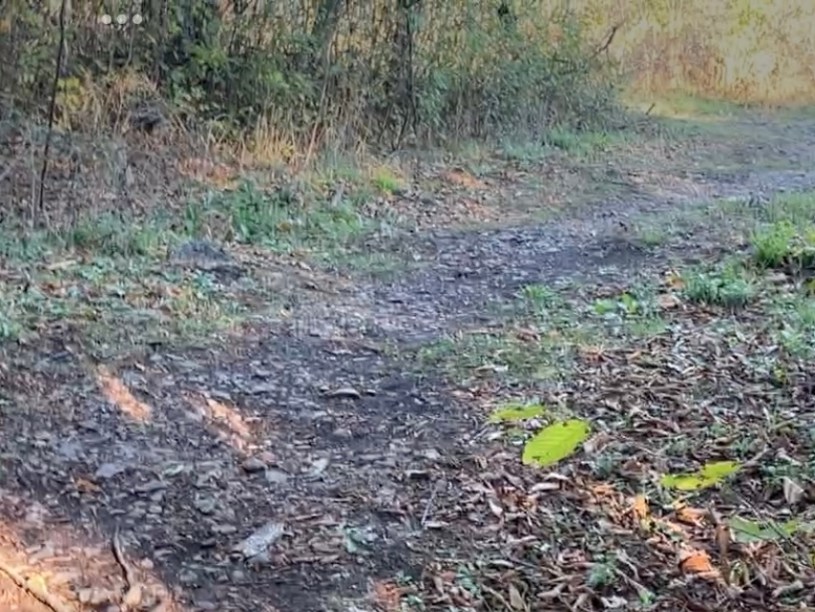
The trail itself was rustic—lots of stones but it was easy to follow. And it was not too onerous to walk, but it was what they might say “locally rugged”. With my leg brace on, it was quite walkable, but it was definitely not for those with other walking disabilities. As we walked along, the leaves had begun to cover the path with autumn colours that made it look like we were walking on a multicoloured carpet. But it also made the rocks sometimes invisible. Andrea says the trail can be very slippery and difficult with the rocks after a rainfall.
The trail wasn’t straight, it seemed to wind its way up and down over the local rocks with little detours to avoid big trees. In the meadow area hawthorn bushes with those prickly branches framed the pathway as it wound its way in no particularly straight manner. It’s not a trail for speed or convenience, but definitely one for reflection. Looking way up or way down offered some interesting visual treasures.
Reveler is known for its birdlife—over 100 species, including the rare eastern meadowlark, bobolink, and loggerhead shrike. I remember seeing meadowlarks in the grasslands near our elementary school when I was a child. I was always amazed at how the meadowlark would fein injury or stay just ahead of potential nest raiders. I can also recall as a child hearing the Bobolink at my grandmother’s farm in Colchester. I haven’t heard one in some time, perhaps due to their threatened habitat. Just the thought of these threatened birds brought back some fond memories.
At one point on the trail, we sat quietly in the meadow, hoping to hear or catch a glimpse, but the birds were elusive that day. Still, the silence felt meaningful, if not weirdly different from our day to day lives.
We also saw very little wildlife, although I am sure toward the evening they magically appear. Andrea has seen porcupines and wild turkeys here before, and of course, squirrels are always nearby.
We ended the walk at the volunteer-maintained bird feeders near the trailhead. A busy chickadee darted in and out, reminding us that in winter, these birds will eat seed right from a child’s hand. A lady with two small children was about to start out on the trail. Hopefully that busy chickadee will come to visit her kids.
This walk wasn’t just about what we saw. It was about slowing down, listening, and sharing space with the land. For me it was a chance to get back to the nature that is so close by but somehow not really a part of our daily lives. With the advent of knee problems, it has been some time since I had walked a little more rugged trail than the suburban recreational trail around our home. And of course the knee problems have kept me away from the good exercise I would enjoy playing golf. It was a good experience walking this trail.
For those, like me, who have never walked the Reveler trail, by all means take the opportunity to do so. The sights are well worth it, and if the birds are around, I’m sure it will be an equally memorable opportunity to experience a symphony of happy sounds that remind us of how valuable nature still is in our busy lives.
For a video tour of this trail check out my YouTube site https://youtu.be/Gj5rgQIMR_Q?si=2qp1uj9snX4c5BfW
 MainstreetRob