My thanks for the historical accounts provided by Murray Barkley and other speakers in a publication commemorating the 150th anniversary of Avonmore in 19921.
Recently I have been doing my “Village Walks” and I was lucky enough to take an extended stroll through the village of Avonmore, Ontario. It is a pleasant community of about 330 residents, about 20 minutes north of Cornwall and about an hour away from Ottawa. Upon entering the community, you cannot help but be overwhelmed by the magnificent homes and the large overhanging Maple trees which at this time of year form a storybook canopy of colourful reds, oranges, yellows, and green leaves. These beautiful homes along this part of Main Street are the result of a railway boom that began in 1886 and brought Avonmore to the forefront as a supply community for forestry and dairy products, and eggs, as well as a host of other transshipment supplies. In that year, the community had a brand-new passenger railway station along the Canadian Pacific Railway tracks between Montreal and Toronto.
The Early Days
Avonmore got on the map of Ontario when the first Post Office was established in 1864. Prior to that time, it was within the domain of founder John Hough who journeyed through the forests covering an area north of Cornwall in 1842 to the Avonmore area. He built a small cabin on the current eastern end of Avonmore and by 1850 had established a sawmill on the banks of the Payne River, close to the current intersection of Main Street and Fairview Rd. A man with many talents, he offered a variety of lumber and specialized wood products, including, among other things, coffins. He eventually became Justice of the Peace, an administrative role akin to judge and sheriff in those early days. He convened the first agricultural Fair in the Avonmore area in 1860.
In 1864 Elias Shaver emerged as a prominent member of the community and built the first general store run by a man named Oscar Fulton. Shaver also established the first post office that year and assumed the role of postmaster which was held in the Shaver family name for over 60 years. Concurrent with this new role, Shaver changed the village name from “Hough’s Mills” to Avonmore. Apparently, Avonmore means “Great River” in Gaelic, but as there does not seem to be a great river close by, more likely it has a less specific meaning, such as peaceful waters. Regardless, Shaver went on to build a blacksmith shop, a tannery, a carriage making shop and eventually became a competing Justice of the Peace to John Hough. Shaver also established a grist mill north of the CPR tracks and west of Main Street that eventually grew significantly with the arrival of a new station on the south side of the tracks in 1885.
Barkleys General Store
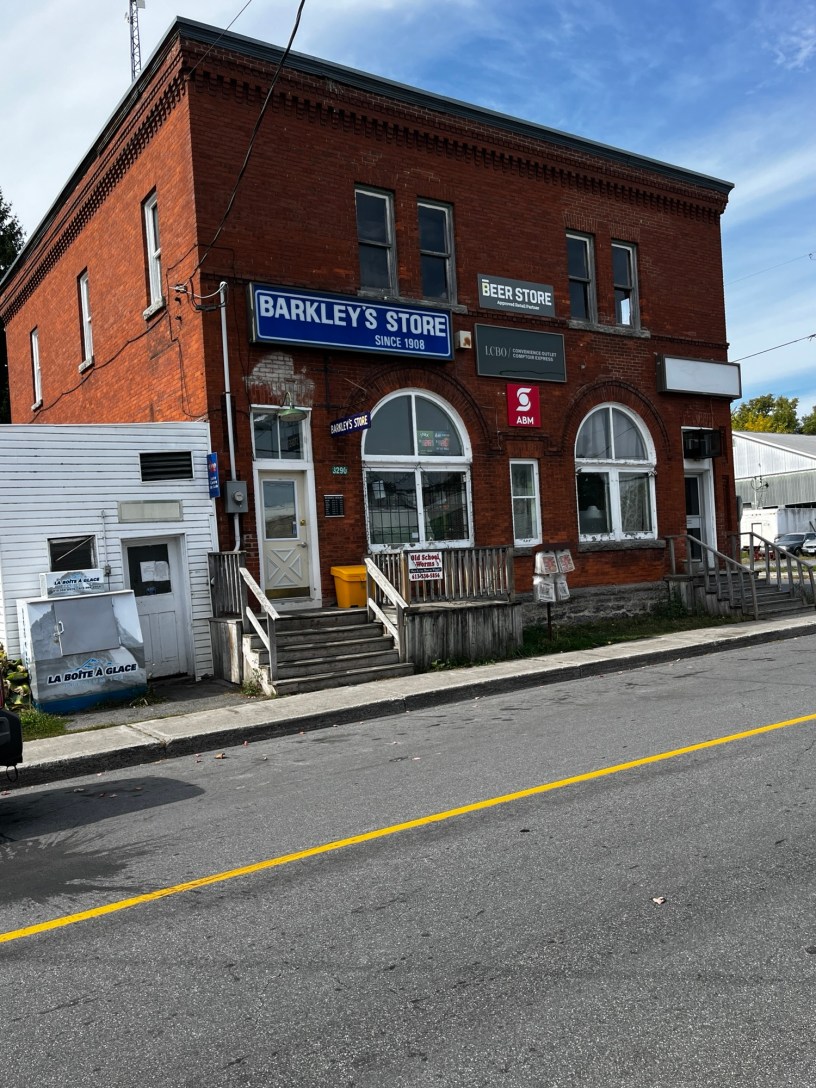
The natural beauty of the surroundings and the neat and tidy appearance of the homes, do not only characterize Main St. It is also evident on the side streets of Avonmore. But the natural focal point of the community is Barkley’s general store. It is a two-story red brick building in the centre of town that you cannot miss. Outside, there is a flower cart with the sign “Sold Out”, but you must wonder when the last time was that the flower cart actually had flowers in it. Above the entrance door two signs are clearly visible – “Beer Store” and “LCBO” – telling everyone that beer and alcohol are available there. So too are worms available: the best, I am sure. They are “Old School Worms”. Not knowing my worm quality, I can only guess that the worms are great for fishing and excellent for whatever else they are used for. To be honest, the store looks like there has been little renovation undertaken since it originally became a general store more than one hundred years ago.
But therein lies its charm, and that store is all about the history of Avonmore. Barkley’s has seen it all – the good times and the slower times. It was run by the Barkley family for three generations, first by Willis Barkley who left Finch with his new bride in the winter of 1908 to establish this store. He initially rented it from the Hough family as John Hough was a very prominent citizen in Avonmore when Willis arrived. In 1919 Willis bought the store. After Willis’s death, his son Fred took over management, and later, his grandson Murray operated the store until its sale in 2014. The Barkley family legacy remains in pictures that still grace the walls of the store. However, the family does not retain ownership anymore.
Barkley’s general store is a vestige of time long ago when the general store was the lifeblood of any rural community. In the early days, general stores offered not only food and groceries, but also clothing, boots, farming gear, tools, and any other essentials that people needed. It was also the source of community information (gossip?), and financially, the source of credit for those experiencing tough times. Today, general stores are becoming anomalies, but in rural communities some still exist, and they are among the last bastions of historical commerce. Many rural residents cling to using these stores, but their pricing and variety can no longer compete with the city big box stores and the online world.
During its earlier time, Barkley’s was an important commercial establishment in the community. It rivalled in economic importance the sawmills, grist mills, dairy, and cheese factories, etc. that were extremely prominent in Avonmore at the turn of the 20th century. At one-point, general stores played such a vital role in Avonmore that there were three in operation—including Oscar Fulton’s shop, which opened in 1864, even before the railway was built.
But let me come back to the “boom” times in a few minutes. Let us go back to Barkley’s. John Begg, a contractor, constructed the store in 1903. Murray Barkley, who was both the final owner of the Barkley store and Avonmore’s most notable historian, referred to it and adjoining businesses as being part of “Begg’s Block”. The entire building complex included a branch of the Bank of Ottawa. This bank was an important one – one of the chartered banks in Canada at the time, and as such, it could issue its own money. This branch included a vault that was eight feet by eight feet in size and had a concrete slab that the owners felt made its contents impregnable. The vault stayed untouched by crime until 1956, when a group of sophisticated bank robbers armed with acetylene torches tried to break in. However, they were caught during their attempt.
The Bank of Ottawa, including that famous vault, was purchased by the Bank of Nova Scotia (BNS) in 1919. The building remained under the BNS banner for many years. The bank was an important part of the community, even after the Bank of Nova Scotia changed its location in 1957 to a location across the street where the drug store currently resides. The Bank of Nova Scotia, like so many banks in rural communities, ceased to operate in Avonmore several years ago, but it still has an ATM machine in Barkley’s general store.
Secret Societies
Rural communities are known for their “brotherhood”, often “secret” societies. One such society, the Independent Order of Oddfellows (IOOF), occupied the hall upstairs on the second floor of the “Begg’s Block”. It had peek holes to check out and admit entrants and two sets of doors to get in. Only members were allowed to formal meetings. The IOOF Lodges were pillars of local life in many rural communities like Avonmore, promoting values of “Friendship, Love, and Truth” while offering support for the sick or disabled, for orphans and widows, and as an organizing committee for local events. IOOF halls often doubled as venues for public meetings, dances, and civic gatherings. When the Barkleys took over the second floor in 1923, they found a magnificent hall, complete with wood wainscotting, an ornate tin roof and elegant hardwood floors.
(While not visible to me during my recent walk through Avonmore, the five-pointed star of the Masonic order is very much present in other rural areas of Eastern Ontario today. The symbolic stars are often seen mounted on the exterior of rural homes and barns. While not exclusively a mark of respect for the fraternal order of the Masons, this symbol is also commonly used to signify protection and good fortune).
The early part of the 20th century was one in which equal rights, helping others and living a moral lifestyle were the mainstays of community living. It was also a time when rural folks had a great sway in government policies. When the IOOF relocated from Begg’s Block to a site across the street in 1918, the United Farmers of Ontario (UFO) took over the hall and used it until 1923. The UFO during those years formed a coalition government in Ontario. It was a populist party in the traditional sense, focusing on better opportunities for rural residents, and among other virtues, moral lifestyles, including alcoholic temperance.
The Roxborough Society Agricultural Exhibition (Avonmore Fair)
The Avonmore Fair has a long history in Eastern Ontario. John Hough’s original event in 1860 went on to be hosted by several communities in Eastern Ontario, but the annual status in Avonmore began after the railway arrived in 1885. The “first annual” celebration drew some opposition due to its lively atmosphere and drinking. The temperance motivated Blue-Ribbon Society of at least twenty local women protested, and perhaps, some ladies even dragged their husbands home to the encouragement of other Society members. However, when the decision arose about hosting the event again in 1886, public enthusiasm was too strong to limit the celebrations linked to the Fair. The Fair was originally located just south and east of present-day Avonmore for the years 1886-1911, but it moved in that last year to the area near Elias Shaver’s grist mill just north of the CPR tracks. The facility remained there until 1920, when a new location behind present day North Stormont Place.
Each year the Fairgrounds come alive with people anxious to see the livestock judging, tractor pulls or exhibitions of baked goods, knitting and crocheting, and flower arranging. Children play on a small midway, get their faces painted or watch child-oriented entertainment. In the evening, the serious festivities start, and headline entertainers keep the music and good times going with friends and family. It is an event shared by thousands of folks in Eastern Ontario and it still competes well with the many summer and fall Fairs that grace the small communities in the region.
The CPR Railway Boom Years
Through the diligent work of Avonmore’s prominent businesspeople, the senior executives of CPR agreed to establish a station in Avonmore in 1885. The new station came complete with a station master’s house and stockyards. Soon after, Avonmore’s business community started shipping lumber, flour from the local grist mill, eggs, and dairy products—including cheese—from nearby mills or factories. The community suddenly had three hotels, including the three-story Grand Union Hotel adjacent to the station. Over its 80-year life that hotel hosted many important businesspeople and family events until it finally burned down in 1967.
The wealth that evolved helped to encourage the development of large homes on Main Street with magnificent porches, ornate woodworking and beautiful lawns and gardens. These homes have been diligently preserved over time, remaining attractive under the tall maple trees that once watched over the splendour of the railway era.
In the past, students travelled on the railway to attend Avonmore High School, which was constructed in 1913. Having a high school was a symbol of community importance and Avonmore was proud of its school. Students who attended would hop on the train to go to school in the morning and return home that evening. Trains often ran along the CPR tracks, sometimes delivering mail up to four times daily. Those passenger trains remained operational through the First World War, sending troops to the east coast, then on to Europe. In the Second World War they would arrive in each rural community to help in enlisting volunteers for the war effort.
The railway brought wealth and innovation. The first automobile appeared in 1912. Prior to joining the provincial electrical grid in 1927, businesses and farms in Avonmore depended on Delco-Light plants—compact, self-sufficient generators that provided electricity to rural Canadians well before hydro lines were available. These units were revolutionary for their time. They allowed shopkeepers, farmers, and homeowners to illuminate their spaces without centralized power.
The arrival of a railway station encouraged dentists practice their trade in Avonmore – the first dentist came in 1923. Luxury product businesses such as jewellery and furniture stores set up shop in the village. By the turn of the century there were already sixty businesses.
Growth Recedes
After WWII, though, things began changing dramatically throughout the rural world as trucks began to displace trains for freight, automobiles appeared in greater numbers and people could travel longer distances. Cities grew in importance. These developments had a serious adverse impact on general stores and other local businesses, as more products became available from specialized stores in urban communities, many at much lower prices.
In 1960 the last passenger train left Avonmore. Since then, the station and the stockyards have disappeared. The factories producing cheese and dairy products, and the sawmills have shut down. The high school has disappeared (although Tagwi High school is located just east of the community). Only Barkley’s and a drug store remain today.
Avonmore today is an attractive community, but workers now commute to the larger communities. The large beautiful Victorian homes remain through a sense of pride and determination among the residents, but Avonmore is no longer a growing community.
Avonmore Berry Farm
The town itself is nice to travel through, but the premiere attraction nowadays is the Avonmore Berry Farm, situated a few kilometers north of the village. Established by the Phillips family in 1981 and commercialized beginning in 1991 it is a hub of enjoyment for those living in Eastern Ontario. They offer pick-your-own strawberries, apples and of course pumpkins (not squash-see another MainstreetRob article). Happy children enjoy sitting on the farm wagons while driven by tractors to the picking locations. They also enjoy the play area, complete with a barn swing over a straw-covered floor. The farm offers a variety of seasonal vegetables, both on-site and through satellite pop-up stands located in several nearby communities. At least one trip annually to the farm is definitely a must for most families in the communities surrounding Avonmore.
Final Thoughts
It may be small, but Avonmore’s history is remarkable for a community of 330 people. From sawmills on the Payne River to railway hotels and ice cream parlours, this village has lived many lives. Some landmarks have faded, but the spirit remains—in Barkley’s general store, in the homes that still line Main Street, in the fairgrounds that come alive each summer, and in the people who continue to shape this place with care and pride.
______________________________________
[1] Avonmore’s 150th anniversary: 1842-1992: a Photo Album of Avonmore
 MainstreetRob