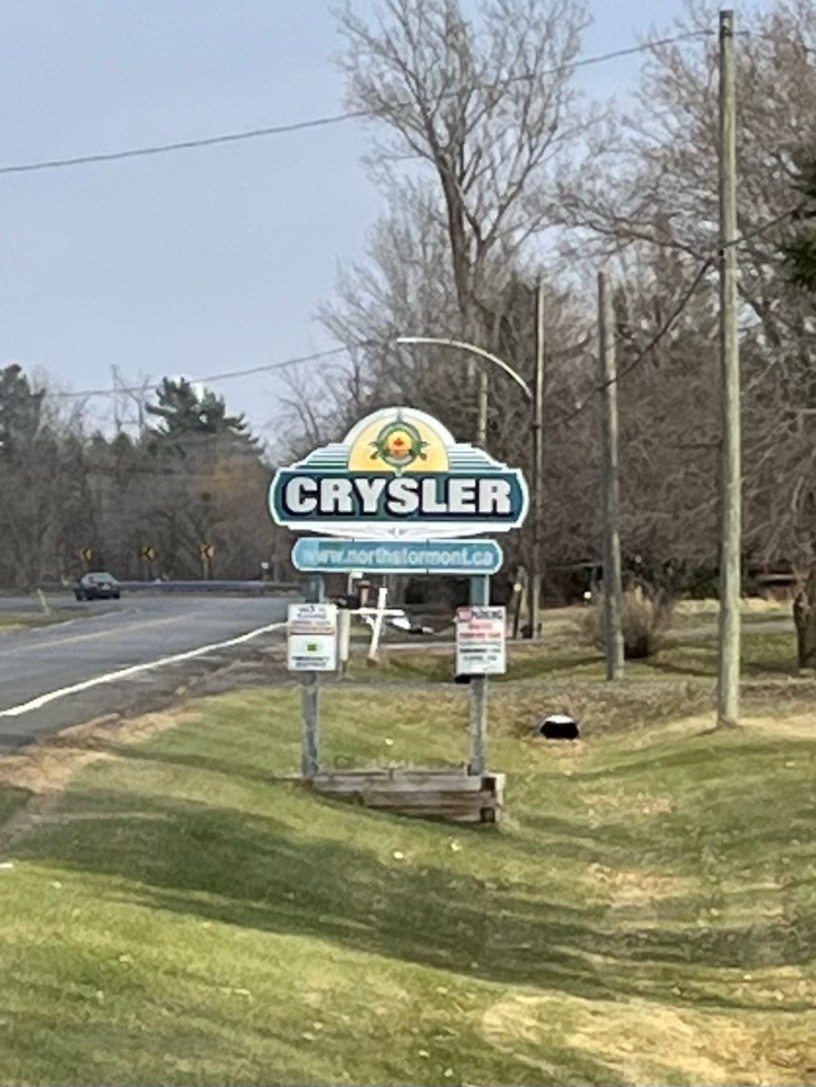
A MainstreetRob History and Description of Crysler, Ontario
Crysler is a small village of about 1200 people located about 35-40 minutes southeast of Ottawa, Ontario. After my first visit, I’ve learned a lot about the history of this community. Unfortunately, the more “history” of Crysler that I find out about, the more muddled the history seems to become. Is this the dilemma historians face? I always thought finding about a community’s history was easy: Find an old timer who can give you the historical run-down; go to the library for some written facts because that’s what local librarians know where to find; wander through the cemeteries to find out who lived there and when they died; check church records; etc., etc. (I have always felt that etcetera was a Latin word for “I can’t think of anything more”?).
I’ve done a little of the above, so let me share some of the interesting findings and my own observations on the history of Crysler. (Please recognize that what follows may not be entirely accurate, but for a small village, how can anyone be entirely accurate?).
Let’s start with John Crysler, last name originally Kraussler, or something like that. His family originally came from Germany but John was born in the U.S. In 1779, as a twelve-year-old, he drummed for Butler’s Rangers, a group of British loyalists who continued to fight against the American Revolutionary forces after 1776. Many of these British loyalists, including the Crysler family emigrated to Canada. John first settled in Lower Canada (Quebec) with his family and then they moved to an area just north of current day Morrisburg Ontario.
Later as an adult, John obtained licenses to operate businesses such as taverns, hotels, mills, etc. He amassed considerable land holdings and established a number of lumber and grist mills. I haven’t been able to find out anything about the taverns?
The “Crysler” name is a well-known name in Canada, synonymous with the defeat of the Americans at (his) Crysler’s Farm in 1813. Without that battle, Canadians could very well be the 51st U.S. state. Were it not for the 800 or so brave soldiers including Crysler who fought under the British banner there and turned back a much larger American force hoping to annex Upper and Lower Canada, Canadians might now have a different national anthem. (Incidentally two years ago our family sat under a shady tree on a sweltering summer afternoon to see the reenactment of that monumental battle at Upper Canada Village. While many of the actors were getting on in age and had some difficulty keeping up, it was great entertainment and made Canadians proud).
After the 1812-14 war, Crysler was given more land and a military promotion, and his land holdings -as much as 60,000 acres -eventually stretched as far north of his home in Williamsburg to an area we now know as Crysler. He remained in the militia and reached the rank of Lt. Col.
Some sources indicate that John Crysler owned a grist and lumber mill on the north side of the South Nation River, then apparently referred to as the Little Nation River. It was a big logging area, and the river was a convenient way to get logs by river to Montreal. Crysler’s logging ventures, while lucrative, managed to get John into trouble as authorities of the time found him to have cut timber from church land and for this he was fined, apparently several times. While his lifestyle is not well documented, at one point he was on the verge of bankruptcy but managed to keep his head above water, so to speak. No doubt there is some remarkably interesting history there, but as they say, “history is not made up of things that are not documented.”
It seems that John Crysler had three wives during his lifetime and nineteen children! (A twentieth son unfortunately died with his mother in childbirth). He and several of his children became prominent citizens in Upper Canada (eastern Ontario), including John Pliny Crysler who some records suggest had land and a house in Crysler(?), and Ralph Crysler, John Pliny’s son, who Catholic records indicate, played a particularly significant role in the growth of the community.
John Crysler Sr. died in 1852 and apparently Crysler was named after him – maybe. Definitely, the John Crysler Park in Crysler is a modern standing tribute to his legacy. It is well used for soccer, baseball, and summer daycare. It is the focal point for Christmas celebrations and the occasional outdoor wedding around the attractive bandshell, and is a gathering point for outdoor events in the village.
When John Sr. died, Ralph inherited a generous portion of land in the area now encompassing Crysler. According to church records he built a flour mill. As a major landowner, he also donated parcels of land to each of the three major churches in the Crysler area at the time. And this set off a church building initiative, with Anglican (1864) and Presbyterian (1881) churches being constructed on the north side of the river, and a Catholic church, originally built in 1868, on the south side.
The latter church has undergone a number of rebuilds over the years, the latest in the year 2000. Its spire can be seen for miles around, competing for highest landmark with the Crysler village water tower. The two north side churches are no longer used (the Anglican Church was unfortunately torn down after being vandalized in the 1990s). The former Presbyterian church is now privately owned but seems to be vacant and require some upgrades.
All of these church buildings were built above the river floodplain, which as history reveals, saw devastating floods that kept Crysler from growing and expanding over the years. Before the first bridge was built in 1890, Crysler area residents were divided by the river. Generally, English-speaking residents, primarily of Irish and Scottish stock, lived on the north side, and French speaking residents – originally from Embrun and Montreal apparently, on the south. Much of the early business activity was concentrated on the north side.
That new bridge did not last long incidentally, as it floated away during the flood of 1891. It wasn’t until 1935 that a solid steel structure was built, and it was upgraded in 1975 with concrete supports. Floods in 1907, 1938, 1950 and 1976 kept tearing the commercial heart of the village south of the river apart.
Eventually a dam was built across the river in 1977 and levees on the south side were constructed in 1984. Since that time, while waters of the South Nation River have gone quite high, serious flooding has not occurred.
Over the years Crysler has gone through booms and busts. At one time the Ottawa and New York Railway traversed the village, adding to its considerable prosperity. One railway station originally sat on the south side of the river at the end of modern-day Station Road, and another across the river on Charles Street at a location currently housing a Home Hardware store.
The railway allowed products to be shipped north to Ottawa or through Cornwall to the United States. It brought prosperity to the surrounding agricultural lands and several manufacturing and processing plants were established. There was a grocery store, cheese manufacturing, furniture manufacturing and retail store, a Royal Bank, a shoe store, several restaurants and dance halls, a hotel, and of course a doctor.
With electricity provided in 1905, Crysler seemed like a progressive growing community, but little growth transpired afterwards as the influence of the railway declined and was eventually closed for good in 1957. One by one businesses on the north side closed down, and today there is very little commercial development there.
Even to this very day, fires have wreaked havoc with local businesses, to the extent that many did not return. And of course, the floods were demoralizing and destructive.
The current commercial heart of the village has evolved through persistent family entrepreneurs building commercial enterprises on the floodplain south of the river. They must have been frustrated by insurance companies reluctant to provide adequate insurance from floods. This has forced many businesses over time to have less than sufficient insurance or to hold back on increasing their investment.
The nunnery that sat across from the Catholic Church for many years has closed its doors, but the General Store remains, with wood floors and bricking that go back to 1902 when it was built. It’s still a going concern and fun to explore. The former Russell Hotel is now a great pizza place with small businesses upstairs and a local pub next door. Some of the buildings on Queen Street have changed their business category but structurally remain. There’s a wine making store with adjoining car wash, and recently, a motorcycle repair shop. An insurance firm, recently closed, will soon be a fruit and vegetable store. There’s a barber shop and a dental hygenist clinic, and a large automotive garage and parts shop. Sadly, though, fire recently destroyed the local chip stand and restaurant. These buildings remain on the floodplain and have seen only a little bit of physical change over the years.
On the south side on safer ground next to the church, there’s a restaurant and attached drug store and just down Queen Street is a modern post office, representing the third-generation postal building in Crysler. There’s even a modern medical clinic, specializing in diabetic care.
Next to John Crysler Park is a community centre and an arena with covered rink. Aside from the perennial winter hockey in the arena, in summer, residents can use pickle ball courts. The arena also hosts popular events like touch-a-truck for kids and a farm equipment show. The community centre, through local volunteers, offer regular dinners and bingo nights, as well as special events.
Adjoining the community centre a library enjoys regular visits from students from the school. The fire hall was recently rebuilt and has a splendid view of the Crysler dam. An esthetician is nearby. Just near the corner of Queen St and Concession 10 (the road to Casselman) is Richer plumbing, a family village stalwart which has served the community for more than three generations. And on Pleasant St. a dog groomer now keeps busy with the many pets habiting the community.
The north side of Crysler along Charles Street has seen no significant commercial development despite its early business history. The exception is the hardware store, cum liquor and beer store and M&M meats. The store is fronted with a large mural commemorating its location as a station stop for an Ottawa-New York Railway steam engine. Just north of town is a landscape material and equipment rental locale, an agricultural equipment supplier, a hairdresser, and a quaint country inn.
While businesses have not grown much, housing development has in recent years changed significantly in Crysler. In the last ten years there have been many new homes built. Construction for more than two hundred-fifty new homes is well underway. Another development nearby will soon build 93 more units. There is talk of another residential development on agricultural land south of Station Road. These developments will change dramatically the Crysler landscape.
Village-provided water and sewer, utility-provided gas, hydro and high speed (fibre) internet have made Crysler an attractive place to live. With the advent of Covid, many residents started working at home, and now, with hybrid hours, they avoid expensive and time-consuming commutes by continuing to work at home.
People are raising families here – there are babies in carriages everywhere and the local daycare is populated with large numbers of children who can easily be dropped off or picked up by commuting parents. That francophone school housing the daycare accepts children of many languages and is renowned for its excellent teaching results and community involvement.
A few years back, twenty-six wind turbines were built in the area west and south of Crysler. This development has provided considerable monetary support to the municipality and despite an original backlash, the wind turbines have taken a unique place in the visual landscape. To be fair, some still dislike the change, but others find it almost futuristic and progressive, not to mention an ongoing reminder of its ecological significance. And these distant but always noticeable windmills are virtually silent in Crysler. On some very still early mornings, notably in the summer, you can hear a very low muffled hum from the turbines in the distance as you walk down the community streets. But as people wake up and begin to go about their daily business, the sound is indistinguishable.
So, ends for now my brief history of Crysler. As time goes on, I suspect I’ll learn more about that history, and maybe add a few things, but I think the future will see much more interesting change in this community. Stay tuned.
If you are interested in seeing a video of mainstreet(s) Crysler and some history of the area, you may wish to check out my Village Walks postings on You Tube. Follow this link https://youtu.be/sndnbJ0iKh0?si=eVSnDouAOmkUvfPU
Sources:
Dictionary of Canadian Biography http://www.biographi.ca/en/bio/crysler_john_8E.html
Wikipedia https://en.wikipedia.org/wiki/John_Crysler , https://en.wikipedia.org/wiki/John_Pliny_Crysler
Notre Dame du Rosaire Parish records http://www.ndr-crysler.ca/ancien/histoire_eng.htm
Chris Granger: Ottawa and New York Railway http://www.nyc-ottawadivision.com/history/railroads/ottawa-and-new-york-railway/
Denise Bourdeau: Research graphic on Historical and Present Map of the Village of Crysler 1812/3 to 2013
 MainstreetRob